|
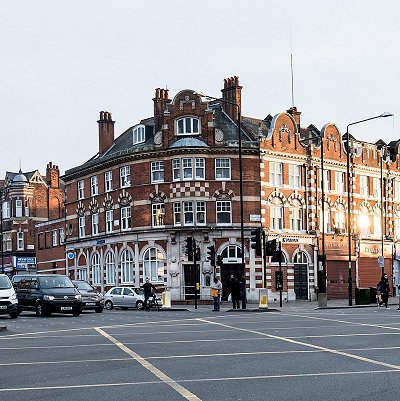
Stamford Hill is an area in Inner London, England, about 5½ miles (9 kilometres) northeast of Charing Cross. The neighbourhood is a sub-district of Hackney, the major component of the London Borough of Hackney, and is known for its Hasidic community, the largest concentration of orthodox Ashkenazi in Europe.
The district takes its name from the eponymous hill, which reaches a height of 108 feet (33 metres) AOD, and the originally Roman A10 also takes the name "Stamford Hill", as it makes its way through the area.
The hill is believed[3] to be named after the ford where the A10 crossed the Hackney Brook on the southern edge of the hill. Sanford and Saundfordhill are referred to in documents from the 1200s, and mean "sand Ford". Roque's map of 1745 shows a bridge, which replaced the ford, referred to as "Stamford Bridge".
The hill rises gently from the former course of the Hackney Brook to the south, and its steeper northern slope provided a natural boundary for the traditional (parish and borough) extent of Hackney, and now does so for the wider modern borough.
Stamford Hill lies on the old Roman road of Ermine Street, on the high ground where it meets the Clapton Road, which runs from central Hackney. By the 18th century, the Roman road (nowadays numbered as the A10) was subject to heavy traffic, including goods wagons pulled by six or more horses, and this caused the surface of the road to deteriorate. The local parishes appealed to Parliament in 1713 for the right to set up a Turnpike Trust, to pay for repairs and maintenance. Gates were installed at Kingsland and Stamford Hill, to collect the tolls.
Roque's map of 1745 shows a handful of buildings around the Turnpike, and by 1795, the A10 was lined with the large homes and extensive grounds of wealthy financiers and merchants attracted, in part, by the elevated position.
Stamford Hill had a gibbet that was used to display the remains of criminals executed at Tyburn in the 1740s. In 1765, a map of the area showed the Gibbet Field south of the road from Clapton Common, behind Cedar House.
The area remained essentially rural in character, and little more was built until the arrival of the railway in 1872, and the tram system at about the same time. Stamford Hill was the point where the tram line coming north from the City met the Hackney tram line, and so, it became a busy interchange, with a depot opening in 1873. Electrification commenced in 1902 and by 1924 a service was commenced between Stamford Hill and Camden Town along Amhurst Park.
Stamford Hill had many eminent Jewish residents, including the Montefiore family. Italian-born Moses Vita Montefiore (died 1789) was living there in 1763. His son Joseph (died 1804) married Rachel Mocatta, and his grandson Abraham Montefiore (died 1824) married Henrietta, whose father, the financier Nathan Meyer Rothschild, lived near the modern Colberg Place from 1818 to 1835. The Montefiores' property a little further south was to be transformed by Abraham's grandson, Claude Montefiore, into Montefiore House school. With the increased development of the area, many distinguished families moved away: In 1842, there were few remaining of the wealthy Jews who had once settled in Hackney. The philanthropist and abolitionist MP Samuel Morley had a residence here from about 1860. The gardening writer and cottage gardener Margery Fish was born here in 1892.
Until the late 20th century, East London was the focus of Jewish life in England, with settlement heavily focussed on an area in and around Whitechapel, extending from Bishopsgate to Cable Street. The area was chosen because of its cheap rents and the independent trades, notably weaving and textiles, known colloquially as "the rag trade". This industry is now commemorated in the name of the Weaver Line railway which serves Stamford Hill.
Prosperity, integration and later severe wartime bomb damage saw the community disperse to other parts of East London and more widely. From the 1880's, Stamford Hill received a new influx of Jews from the core area of East End settlement and, in 1915, the New Synagogue was transferred to Stamford Hill to serve this growing population.
In 1926, the Union of Orthodox Hebrew Congregations was established in Stamford Hill, and this became a magnet for other strictly observant Jews, many fleeing Nazi persecution in the years before the Second World War. Also, many Jewish families came to the area from other areas of London, refugees in their own way from bombing and post-war clearances for new housing. One of the early Hasidic leaders in Stamford Hill was the Shotzer Rebbe. The Hungarian uprising also led to an influx of Haredi Jews fleeing hardship under Soviet rule. Another notable Jewish resident, from 1955 until his death in 2000, was the spiritual head of the Union of Orthodox Hebrew Congregations, Rabbi Chanoch Dov Padwa.
|