|
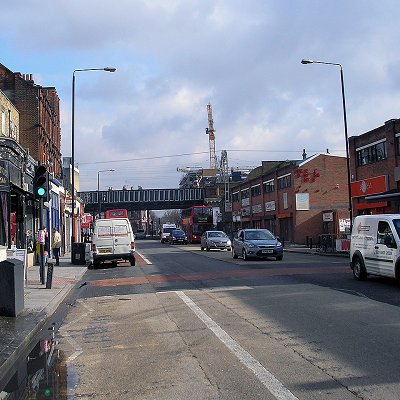
Cambridge Heath is an urban area of Bethnal Green in the London Borough of Tower Hamlets, approximately 5.7 km (3.5 mi) north east of Charing Cross. It is named after a former heath in the East End of London. The northern boundary is formed by the Regent's Canal and the area includes Vyner Street, best known for its street art and galleries.
The area is served by Cambridge Heath railway station, operated by London Overground.
The earliest written use of the name was by a scribe in the era of great orthographic variety, as Camprichthesheth, in 1275; other manifold variations soon followed. It could be unconnected with Cambridge instead from an Old English plant (such as comfrey) or unusual-form man's name. The area was once marshland and forest which, as Bishopswood, lingered in the east until the 16th century.
Cambridge Heath and Bethnal Green proper were unequal halves of the same manor, and in the 19th century both formed part of the Metropolitan Borough of Bethnal Green. This was incorporated into the newly created London Borough of Tower Hamlets in 1965.
It is north and west of Bethnal Green, east of Haggerston, south-west of Hackney and west of Victoria Park.
It is largely part of the wider Regents Canal Conservation Area, established in 2008, the streetside buildings seem neglected but form part of the industrial heritage and character of Vyner Street and also Wadeson Street, which contains a row of three-storey Victorian workshops mostly converted to residential use. Both types contribute to the character of the area.
|