|
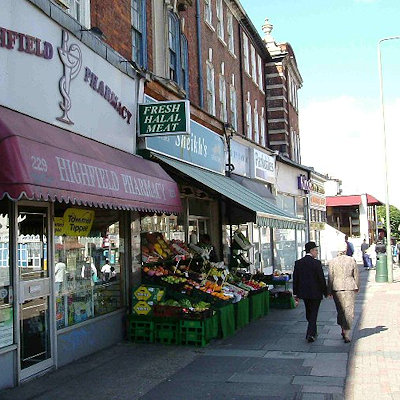
Golders Green is an area in the London Borough of Barnet in England. Although the settlement history goes back to the 18th century, Golders Green is essentially a late 19th-century suburban development. It is situated approximately 5.5 miles (8.5 km) north west of Charing Cross and centred on the intersection of Golders Green Road and Finchley Road.
It was historically part of Middlesex, and formed part of the Municipal Borough of Hendon until 1965. In the early 20th century it grew rapidly in response to the opening of a tube station of the London Underground, adjacent to the Golders Green Hippodrome which was home to the BBC Concert Orchestra for many years. The area has a wide variety of housing and a busy main shopping street, Golders Green Road.
It is known for its large Jewish population as well as for being home to the largest Jewish kosher hub in the United Kingdom, which attracts many Jewish tourists.
The name Golders comes from a family named Godyere who lived in the area, and Green alludes to the manorial waste on which the settlement was built. Golders Green has been a place in the parish and manor of Hendon since around the 13th century. The earliest references to the name of the adjacent district of "Temple Fortune" is on a map (c. 1754). However this name reveals a much earlier history. It is likely that the name refers to the Knights of St John, who had land here (c. 1240). Fortune may be derived from a small settlement (tun) on the route from Hampstead to Hendon. Here a lane from Finchley, called Ducksetters Lane (c. 1475), intersected. It is likely that the settlement was originally the Bleccanham estate (c. 10th century). By the end of the 18th century Temple Fortune Farm was established on the northern side of Farm Close.
The building of Finchley Road (c. 1827) replaced Ducksetters Lane as a route to Finchley, and resulted in the development of a small hamlet. Hendon Park Row (c. 1860s) is of this period, and consisted of around thirty small dwellings built by a George Stevens, which were, with two exceptions, demolished around 1956. A small dame school and prayer house run by Anglican deaconesses existed in the 1890s and 1900s, and developed to become St. Barnabas (1915). Along Finchley Road were a number of villas (c. 1830s), joined by the Royal Oak public house (c. 1850s). By the end of the 19th century there were around 300 people living in the area, which included a laundry and a small hospital for children with skin diseases. The principal industry was brick making.
In 1895 a Jewish cemetery was established adjacent to Hoop Lane, with the first burial in 1897. Golders Green Crematorium was opened in 1902 (although much of it was built after 1905). A significant moment in Temple Fortune's development into a suburban area occurred in 1907, when transport links were vastly improved by the opening of Golders Green tube station.
Although the area had been served by horse-drawn omnibuses (since at least the 1880s) and later motor buses (from 1907), the tram line of 1910, connecting Finchley Church End with Golders Green Station, led to the development of the area west of Finchley Road. The establishment of Hampstead Garden Suburb brought major changes to the area east of Finchley Road. Temple Fortune Farm was demolished and along the front of the road the building of the Arcade and Gateway House (c. 1911) established the Hampstead Garden Suburb's retail district.
Both the Golders Green Hippodrome, former home of the BBC Concert Orchestra, and the police station opened in 1913. The now-demolished Orpheum Theatre (1930) was intended to rival the Hippodrome in Golders Green.
|