|
Shacklewell is a small locality to the east of Roman Ermine Street (now the A10), in the London Borough of Hackney.
The area was originally a hamlet that developed on Shacklewell Lane in the Ancient Parish and later Metropolitan Borough of Hackney, now a part of the larger modern London Borough of Hackney. The place name is no longer commonly used, and the areas is now generally regarded as part of Dalston, which was originally a separate hamlet 500 yards to the south, and also part of the Parish and Borough of Hackney.
Shacklewell took its name from "some springs or wells which were of high repute in former days, but the very site of which is now forgotten."
The place name was first recorded in 1490, when Thomas Cornish, a London saddler, had a tenant there.
The hamlet was one of four small settlements within the Parish of Hackney, (Dalston, Newington, Shacklewell, and Kingsland), which were all grouped for assessment purposes, together having only as many houses as the village of Hackney. The village of Shacklewell was settled on the eponymous village green, along Shacklewell Lane.
Shacklewell lay a little over 500 yards north of the hamlet of Dalston, which stood on Dalston Lane, with which it was linked by Cecilia Road.
John Heron, reputedly the richest man in Hackney, with extensive land-holding had his manor house at Shacklewell. Cecilia More, the youngest daughter of Sir Thomas More, the Roman Catholic martyr, married into the family in 1525. The house was later occupied by the Tyssen family, who owned large parts of Hackney.
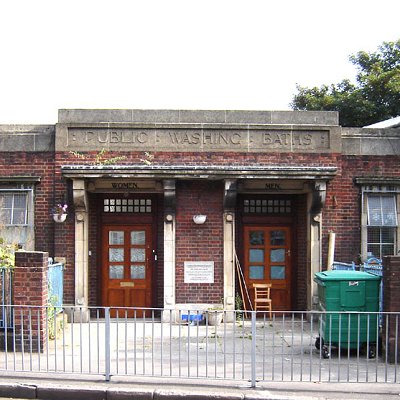
One municipal building still standing is the former Shacklewell Washing Baths. This was a communal bath and washhouse. Simple bathhouses like these were once of great importance. Even into the 1960s, in some working-class areas of London many dwellings did not have their own bathrooms.
Largely residential in the mid-19th Century, the district gained some light industry later on, including Eyre & Spottiswoode's printworks and a saw mill. Although some industry remains, largely in Turkish hands, the area is no longer a significant commercial centre.
Although the place name is now little used, the historic street pattern of the original hamlet remains.
|