|
Crouch End grew up as a hamlet on the old medieval route from London to the north. At this time it was governed as part of Hornsey, which became a parish in around 1300. The name "Cruch End" is recorded in 1593. This heavily wooded area contained farms and country houses, one of which was Crouch Hall, probably built in 1681 at the crossroads of Crouch End. The transcribed 1829-1848 diaries of William Copeland Astbury, recently made available, describe in great detail London life of the period, including walks to Crouch End. Crouch End remained rural until around 1880. Large parts remained in private ownership, inhibiting development. However, the development of the railway changed the area significantly. By 1887 there were seven railway stations in the area. Crouch End became a prosperous middle-class suburb due to an influx of mainly clerical workers who could easily commute to the city. The large old houses were replaced by comfortable middle-class housing, public parks were created, and a number of new roads and avenues, such as Elder Avenue and Weston Park, were laid out.
It expanded greatly in the late Victorian period and most of its present-day streets were built up in the late 19th century.
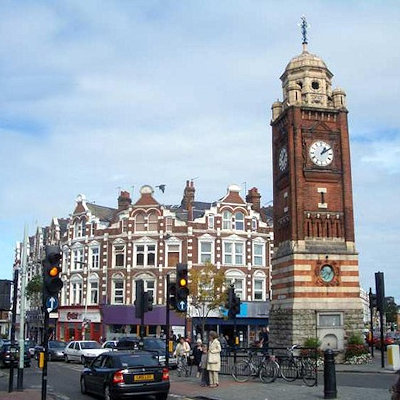
By the mid-1930s Crouch End had a popular shopping centre that included a Music Hall in the middle of Topsfield Parade.
Until 1965 it was administratively part of the Municipal Borough of Hornsey and that body's forerunners. In 1965, when local government in London was reorganised, Hornsey merged with the boroughs of Wood Green and Tottenham, and Crouch End became part of the London Borough of Haringey.
In the post-war years, the London-wide provision of social housing led to the building of council homes in and around Crouch End, Hornsey Vale and Hornsey itself. Many of the older houses in the area lay empty post-war and many were bought cheaply by speculative landlords who then let them out to the growing student populations of the Mountview and Hornsey Art College as well as to artists and musicians, who flocked to the area because of cheap rents. The area became known as student bedsit land for several decades into the early '80s until gentrification of the area changed the social profile and it became progressively more middle class. These social changes were illustrated by the changes in the shop types over the period[citation needed]; gentrification brought estate agents en masse along with up-market establishments and pavement-type cafes.
|