|
Canonbury is a residential district in the London Borough of Islington in the north of London. It is roughly in the area between Essex Road, Upper Street and Cross Street and either side of St Paul's Road. In 1253 land in the area was granted to the Canons of St Bartholomew's Priory, Smithfield, and became known as Canonbury. The area continued predominantly as open land until it was developed as a suburb in the early nineteenth century. In common with similar inner London areas, it suffered decline when the construction of railways in the 1860s enabled commuting into the city from further afield. The gentrification of the area from the 1950s included new developments to replace war-damaged properties in Canonbury Park North and South as well as restoration of older buildings.
East Canonbury is the south-eastern corner of the district, bordering on the Regents Canal. Parts of this area were transferred to the district from the London Borough of Hackney in a boundary adjustment (along the line of the northern towpath of the canal), in 1993.
In the east is the New River Estate (formerly the Marquess Estate), a 1,200 dwelling council estate, completed in 1976 on 26 acres, and designed by Darbourne & Darke. A dark red brick, traffic free estate, it was praised as an example of municipal architecture, but acquired a bad reputation and has since been extensively redeveloped to improve security for residents.
Places of interest include:
- Canonbury Tower - The manor house of Canonbury was constructed by William Bolton of St Bartholomew’s Priory between 1509 and 1532. At the dissolution it was granted to Thomas Cromwell. In the 1590s the manor house was rebuilt by Sir John Spencer, Lord Mayor of the City of London, including the construction of its tower. The tower has been occupied by many historical figures, including Francis Bacon and Oliver Goldsmith. The Tower Theatre Company was based here from 1953 to 2003. It is currently used as a Masonic research centre.
- Canonbury Square - An attractive square, developed between 1805 and 1830, it includes a variety of distinct styles. In 1812, when few properties had been built, the New North Road turnpike, now known as Canonbury Road, was constructed and bisects the square. Many significant figures from the arts and literary worlds have lived on the square, including George Orwell, Evelyn Waugh and Samuel Phelps.
- The Estorick Collection of Modern Italian Art is in Canonbury Square.
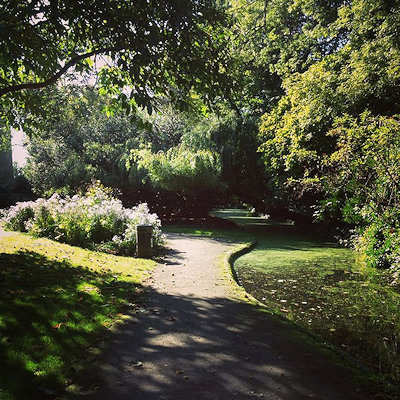
- New River Walk - The New River, an aqueduct built by Sir Hugh Myddelton to supply fresh water to London, was completed in 1613. The walk is in two parts, with a break at Willowbridge. The southern section received an early National Lottery grant, and has a back-pumping scheme which simulates the water flow of the original aqueduct.
- Canonbury Grove - a road running parallel to part of New River Walk, made up of typical attractive 2 and 3 storey early 19th century terraces.
|