|
Highbury is an area of North London, England, in the London Borough of Islington.
Highbury was once owned by Ranulf, brother of Ilger, and included all the areas north and east of Canonbury and Holloway Roads.
The manor house was by what is now the east side of Hornsey Road, near the junction with Seven Sisters Road. After the manor decayed, a new manor house was built in 1271 to the south-east; to differentiate it from the original manor and because it was on a hill, it was called Highbury, from which the area takes its name.
The site for Highbury Manor was possibly used by a Roman garrison as a summer camp. During the construction of a new Highbury House in 1781, tiles were found that could have been Roman or Norman.
Ownership of Highbury eventually passed to Alicia de Barrow, who in 1271 gave it to the Priory of St John of Jerusalem, also known as the Knights Hospitallers in England. The wealthy Lord Prior built Highbury manor as a substantial stone country lodging with a grange and barn.
In 1381, during the Peasants' Revolt, Jack Straw led a mob of 20,000 rioters who "so offended by the wealth and haughtiness" of the Knights Hospitallers destroyed the manor house. The Lord Prior at the time, Robert Hales, who had taken refuge in the Tower of London, was captured and beheaded on Tower Hill. Jack Straw and some of his followers used the site as a temporary headquarters; consequently the derelict manor became known for the next 500 years as Jack Straw's Castle. This should not be confused with the better known Jack Straw's Castle, formerly a pub and now residential flats at Whitestone Ponds, Hampstead, which was named after the semi-legendary leader of the revolt.
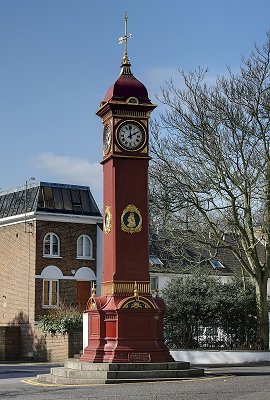
Highbury Clock Tower is located just north of Highbury Fields, near the junction of Highbury Barn and Highbury Hill. It was presented in 1897 in celebration of the 60th anniversary of the reign of Queen Victoria. The Manor of Highbury remained the possession of the Knights of St John until it was confiscated by Henry VIII in 1540. The land then stayed as crown property until Parliament began selling it in the 17th century.
John Dawes, a real estate developer, acquired the site of Jack Straw's Castle together with 247 acres (1.00 km²) of surrounding land. In 1781 he built Highbury House at a cost of £10,000 on the spot where Highbury Manor had stood. Over the next 30 years the house was extended by new owners, firstly Alexander Aubert and then John Bentley, to include a large observatory and lavish gardens.
The grounds around Highbury House started to be sold off in 1794. By 1894 Highbury House and its remaining grounds became a school. Finally in 1938 Highbury House was demolished and is now the site of Eton House flats (on Leigh Road), built by the Old Etonian Housing Association in 1939.
After the Manor house had been destroyed in 1381, the grange and barn remained on the east side of the track that ran south to Hopping Lane, now St Paul's Road, roughly on the line of Highbury Park / Highbury Grove (the A1201). In 1740 a small ale and cake house was opened in the Barn, Highbury.
In 1770 William Willoughby took over Highbury Barn and greatly increased its popularity. He expanded its size and facilities, taking over land and buildings from the farm next door, reaching beyond what is now Kelvin Road and created a bowling green, trap-ball grounds and gardens. It could cater for company dinners of 2,000 people, concerts and dancing and became one of the most popular venues in London.
In 1854 events at the annual balls in the grounds of the Barn included the aeronaut Charles Green's balloon ascent. By 1865 there was a huge dancing platform, a rebuilt theatre, high-wire acts, pantomime, music hall and the original Siamese twins. The Barn became the victim of its own success. After a riot led by students from Bart's Hospital in 1869, locals complained about the Barn's increasingly riotous and bawdy clientele. This led to a court case and in 1871 authorities revoked the Barn's dancing licence.
In 1913 Woolwich Arsenal F.C. moved north to Highbury, dropping Woolwich from its name. Their chairman Sir Henry Norris took a 20-year lease on part of the grounds of St John's Hall for £20,000. The new Arsenal Stadium (also called Highbury) was built there. St John's Hall, originally called Highbury College (of Divinity), was built in 1825 on what is now Aubert Park and was a grand ionic-style building, reminiscent of the British Museum. St John's Hall burnt down in 1946 and was replaced by a block of flats.
The club prospered and by 1925 had purchased the freehold. Arsenal's subsequent success made Highbury well known, albeit initially with depressing effect on nearby housing. In 2006 the club moved to Ashburton Grove on the west side of Drayton Park in Highbury. The old stadium was converted into a luxury housing complex known as Highbury Square, with the two listed main stands being converted into apartments, ensuring their original exteriors remained almost entirely preserved. The unlisted North Bank and Clock End stands have been demolished to make way for entirely new apartment blocks. The pitch has been converted into a garden, with private gym and swimming pool located underneath it. Today, property in the area around the old Highbury stadium is highly sought after, and prices for apartments within the stadium start at £300k.
|