|
Edmonton is 8.6 miles (13.8 km) north-north-east of Charing Cross and stretches from just south of the North Circular Road where it borders Tottenham to its boundary with Ponders End to the north. Bush Hill Park, Winchmore Hill and Palmers Green adjoin the western boundary while the River Lee Diversion forms Edmonton's eastern boundary with Chingford. The northern part of Edmonton, N9 postal area is known as Lower Edmonton and the southern part as Upper Edmonton, N18 postal area.
The old highway Ermine Street passed through what is today Edmonton. Ermine Street was the main Roman Road from London through Lincoln and on to York. Edmonton appears in the Domesday Book of 1086, where it is recorded as Adelmetone- 'a farmstead or estate of a man called Eadhelm' from an Old English personal name and tun.
Edmonton Hundred was a division of the historic county of Middlesex from Saxon times, an area of some 31,000 acres stretching up the west bank of the Lea from Tottenham to the county boundary south of Waltham Cross, and west into what is now Hertfordshire as far as South Mimms. Local government in the modern sense began in 1837 with the Edmonton Union, set up under the Poor Law Amendment Act 1834. This also covered a wide district of 47,102 acres, including the modern boroughs of Haringey and Enfield, plus Cheshunt, Waltham Abbey and Waltham Cross. The town hall was built in 1884 and extended in 1903.
The population of this area grew rapidly, reaching 445,875 by 1911 and would today be about 615,000. As the population mushroomed Middlesex was subdivided into many small local government areas, a much smaller Edmonton of 3894 acres eventually achieving the status of borough in 1937. At the 1961 census the borough had a population of 91,956. This was absorbed into the London Borough of Enfield in 1965, and the former Town Hall and civic buildings were controversially demolished by Enfield Council in 1989.
Pymmes Park with its historic walled garden is Upper Edmonton's park. Pymmes Park originated as a private estate. In the late 16th century it was owned by the powerful Cecil family. In 1589 Robert Cecil, later 1st Earl of Salisbury, spent his honeymoon at Pymmes. Cecil was a protege of Francis Walsingham, Elizabeth I's chief spymaster and he succeeded him as Secretary of State in 1590. The estate was eventually acquired by Edmonton Council and opened as a public park in 1906. Pymmes House was destroyed by fire during World War II and the remains were demolished.
In the 17th century the then rural Edmonton had a reputation for supernatural activities. In approximately 1600, a play entitled The Merry Devil of Edmonton was performed in London about a wizard who lived there. In 1621 the villagers accused an old woman, Elizabeth Sawyer, of witchcraft and she was subsequently executed at Tyburn; her story was told in a pamphlet by Henry Goodcole, and in a 1621 play entitled The Witch of Edmonton.
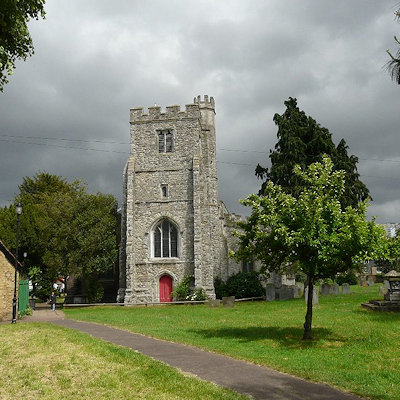
The historic All Saints' Church is situated in Church Street as is Lamb's Cottage, which was home to writers Charles Lamb and Mary Lamb.
John Keats, the poet, was apprenticed to surgeon Dr. Hammond in Church Street between 1810-1816. The house was demolished in 1931 to be replaced by Keats Parade. An extant shop carries a blue plaque in commemoration.
Edmonton was the home town of Sir James Winter Lake, director of the Hudson's Bay Company. The company's trading outpost named after Edmonton is now the capital of the Canadian province of Alberta.
|