|
The area was previously a village known as Battle Bridge or Battlebridge which was an ancient crossing of the River Fleet. The original name of the bridge was Broad Ford Bridge. The corruption "Battle Bridge" led to a tradition that this was the site of a major battle in AD 60 or 61 between the Romans and the Iceni tribe led by Boudica (also known as Boudicea).
The tradition claims support from the writing of Publius Cornelius Tacitus, an ancient Roman historian, who described the place of action between the Romans and Boadicea (Annals 14.31), but without specifying where it was; Thornbury addresses the pros and cons of the identification. Lewis Spence's 1937 book Boadicea - warrior queen of the Britons includes a map showing the supposed positions of the opposing armies. The suggestion that Boudica is buried beneath platform 9 or 10 at London King's Cross Station seems to have arisen as urban folklore since the end of World War II. The area had been settled in Roman times, and a camp here, known as The Brill was erroneously attributed to Julius Caesar, who never visited Londinium. The name is commemorated in two streets lying behind King's Cross and St Pancras stations. St Pancras Old Church, also set behind the stations, is said to be one of the oldest Christian sites in Britain.
The current name has its origin in a monument to King George IV which stood in the area from 1830 to 1845. It was built at the crossroads of Gray's Inn Road, Pentonville Road and New Road, which later became Euston Road. It was sixty feet high and topped by an eleven-foot-high statue of the king, and was described by Walter Thornbury as "a ridiculous octagonal structure crowned by an absurd statue". The statue itself was constructed of bricks and mortar, and finished in a manner that gave it the appearance of stone "at least to the eyes of common spectators". The architect was Stephen Geary, who exhibited a model of "the Kings Cross" at the Royal Academy in 1830. The upper storey was used as a camera obscura while the base in turn housed a police station and a public house. The unpopular building was demolished in 1845, though the area has kept the name of Kings Cross. A structure in the form of a lighthouse was built on top of a building almost on the site about 30 years later. Known locally as the "Lighthouse Building", the structure was popularly thought to be an advertisement for Netten's Oyster Bar on the ground floor, but this seems not to be true. It is a grade II listed building.
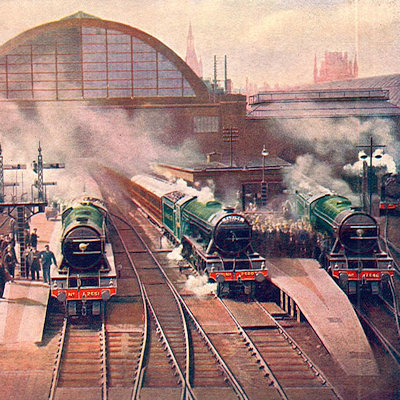
London King's Cross railway station now stands by the junction where the monument stood and took its name. The station, designed by architect Lewis Cubitt and opened in 1852, succeeded a short-lived earlier station, erected north of the canal in time for the Great Exhibition.
St Pancras railway station, built by the Midland Railway, lies immediately to the west. They both had extensive land ("the railway lands") to house their associated facilities for handling general goods and specialist commodities such as fish, coal, potatoes and grain. The passenger stations on Euston Road far outweighed in public attention the economically more important goods traffic to the north. King's Cross and St Pancras stations, and indeed all London railway stations, made an important contribution to the capital's economy.
For readers of Harry Potter, London King's Cross is where the schoolboy hero boards the train for Hogwarts. The railway station has capitalised on tourist interest by putting up a sign for the fictional "Platform 9¾" described in the books, and burying a luggage trolley half into the wall. Film adaptations have used platforms 4 and 5 for some scenes.
Nearby attractions include:
- Platform 9¾.
- Camden Town Hall.
- The British Library.
- Camley Street Natural Park.
- London Canal Museum.
- House of Illustration.
- St Pancras Old Church.
- King's Place.
- Charles Dickens Museum.
- The Foundling Museum.
- Guildhall Art Gallery.
- Gagosian Gallery.
- British Postal Museum and Archive.
- Gasholder No. 8.
- Royal Mail Mount Pleasant Sorting Office.
|