|
The London Borough of Hackney is a North East London Borough within Inner London, United Kingdom.
Southern and eastern parts of the borough are popularly regarded as being part of east London, with northern and western areas belonging to north London.
Hackney is bounded by Islington to the west, Haringey to the north, Waltham Forest to the north-east, Newham to the east, Tower Hamlets to the south-east and the City of London to the south-west. Much of Hackney retains an inner-city character, but in such places as Dalston large housing estates have been joined by newly developed gated communities. In South Hackney, near Victoria Park, terraced Georgian, Victorian and Edwardian housing still survives.
The historical and administrative heart of Hackney is the area roughly extending north from Mare Street and surrounding the Church of St John-at-Hackney; known as Hackney Central. To the north of the borough are Upper Clapton and Lower Clapton, Stamford Hill and Stoke Newington. To the east is the large open space of Hackney Marshes and the districts of Hackney Wick and Homerton. Light industries in the area around the River Lea employ over 3,000 people. Some of the area was used for the 2012 Summer Olympics.
In the 13th century the name appears as Hackenaye or Hacquenye, but no certain derivation is advanced. The Concise Oxford Dictionary of Place Names (fourth edition) discusses the origin of the name. The first surviving records of the place name are as Hakney (1231) and Hakeneye (1242 and 1294). The ey suffix almost certainly refers to an island; the dictionary favours the interpretation that Hackney means 'Haka's island,' with Haka being a notable local person and the island (or inaccessible place surrounded by marshes) lying close to the River Lea. This was once a much wilder place than today.
The Dictionary suggests that the Hack element may also derive from:
- The Old English 'Haecc' meaning a hatch - an entrance to a woodland or common.
- Or alternatively from 'Haca' meaning a hook, and in this context, a bend of the river.
Given the island context, the 'hatch' option is unlikely to be correct, so the favoured 'Haka's Island' or the 'Island on the bend' seem more likely.
The place name will have originally referred to just the island or possibly both the island and the manor of the same name based around it. Subsequently, the name Hackney was applied to the whole ancient parish of Hackney.
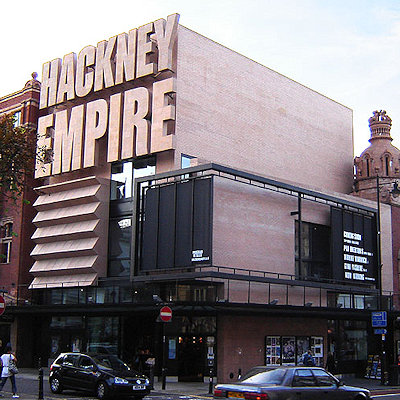
There are 1,300 listed buildings in Hackney, including the Hackney Empire, Tudor Sutton House, and the Grade I medieval St Augustine's Tower. The borough contains 25 conservation areas including Clapton Square and urban open-spaces including Clapton Common and Clissold Park. Conservation areas also protect large areas of Georgian and Victorian housing, and areas of industrial heritage.
|