|
Laid out as a residential district from 1791 and originally part of the manor of Kentish Town and the parish of St Pancras, London, Camden Town became an important location during the early development of the railways, which reinforced its position on the London canal network. The area's industrial economic base has been replaced by service industries such as retail, tourism and entertainment. The area now hosts street markets and music venues which are strongly associated with alternative culture.
Camden Town is named after Charles Pratt, 1st Earl Camden. His earldom was styled after his estate, Camden Place near Chislehurst in Kent (now in the London Borough of Bromley), formerly owned by historian William Camden. The name, which appears on the Ordnance Survey map of 1822, was later applied to the early 20th century Camden Town Group of artists and the London Borough of Camden, created in 1965.
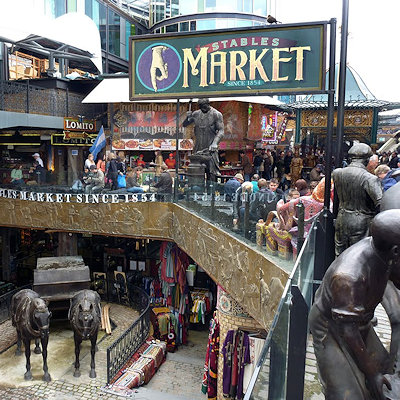
Camden is well known for its markets. These date from the 1970s or later, except for Inverness Street market, for over a century a small food market serving the local community, though by 2013 all foodstuff and produce stalls had gone, leaving only touristy stalls. Camden Lock market proper started in a former timber-yard in 1973, and is now surrounded by five more markets: Buck Street market, Stables market, Camden Lock village, and an indoor market in the Electric Ballroom. The markets are a major tourist attraction at weekends, selling goods of all types, including fashion, lifestyle, books, food, junk/antiques and more bizarre items; they and the surrounding shops are popular with young people, in particular those searching for "alternative" clothing.
The Regent's Canal runs through the north end of Camden Town. Canal boat trips along the canal from Camden Lock are popular, particularly in summer. Many of the handrails by the bridges show deep marks worn by the towropes by which horses pulled canal barges until the 1950s, and it is still possible to see ramps on the canal bank designed to assist horses which fell in the canal after being startled by the noise of a train. Camden Lock is a regularly used traditional manually operated double canal lock operating between widely separated levels. A large complex of weekend street markets operate around the Lock. The towpath is a pedestrian and cycle route which runs continuously from Little Venice through Camden Lock to the Islington Tunnel. A regular waterbus service operates along the Regent's Canal from Camden Lock. Boats depart every hour during the summer months, heading westwards around Regent's Park, calling at London Zoo and on towards Maida Vale. Sightseeing narrow-boat trips run from Camden Lock to Little Venice.
The Roundhouse is a locomotive engine roundhouse constructed in 1847 for the London & North Western Railway. It later had various uses and eventually became derelict. It was converted to a theatre, arts centre and music venue in the 1966, later closed, and re-opened in 2006 as a theatre and music venue.
Historic places include:
- Camden catacombs (see also Catacombs of London), not true catacombs but an underground area largely underneath the Camden markets, originally used as stables for horses and pit ponies used to shunt railway wagons. Not open to visitors due to danger of flooding.
- St Pancras Old Church.
- The Camden Eye at 2 Kentish Town Road, was formerly known and as the Old Mother Red Cap, the Red Cap and Halfway House. It was also used as a prison.
- St Michael's Church, Camden Town.
- The Carreras Cigarette Factory (now Greater London House), a striking Art Deco Egyptian Revival building dating from 1926 to 1928, stands at Mornington Crescent and is distinguished by a pair of 8.5-foot (2.6 m)-high bronze statues of the Egyptian cat goddess Bastet.
- Jewish Museum.
- Arlington House, a hostel for the homeless, one of the Rowton Houses.
- The unusual Sainsbury's supermarket and flats on Camden Road were designed in a High-tech style by Nicholas Grimshaw and built on the site of the former large ABC Bakery.
- 8 Royal College Street, the house of the French poets, Arthur Rimbaud and Paul Verlaine.
- Bedford Music Hall: Used to stand on Camden High Street.
- Since 2015, Camden Collective have been using the National Temperance Hospital ahead of its likely demolition for HS2 at Euston.
- Greater London House, a former Egyptian Cigarette factory and now the Global Headquarters of ASOS.com.
|