|
The area's name derives from that of an estate called Arnoldes Grove or Arno's Grove, i.e. 'grove or copse of the Arnold family'. The Arnolds were local landowners who are mentioned in documents dating from the 14th century.
Until the 1930s Arnos Grove was largely undeveloped and rural, and not considered to be an area in its own right. Instead, it was considered to be part of Southgate, although in the late 19th century the area of Colney Hatch (which later became known as New Southgate) began to grow nearby.
Arnos Grove was, until the dissolution of the monasteries by Henry VIII, owned by the Nuns of Clerkenwell. It was known as Armholt Wood in the 14th century, and later as Arnolds. A Tudor manor house was erected on the site, but was demolished in 1719 - presumably by James Colebrook, who bought the estate in the same year and built a mansion called Arnolds in Cannon Hill, Southgate. Locals called the estate Arno's and the next owner, Sir William Mayne (later Lord Newhaven), renamed the house and estate Arnos Grove, which is now pronounced as though it never had an apostrophe. In 1777, it was bought by Isaac Walker.
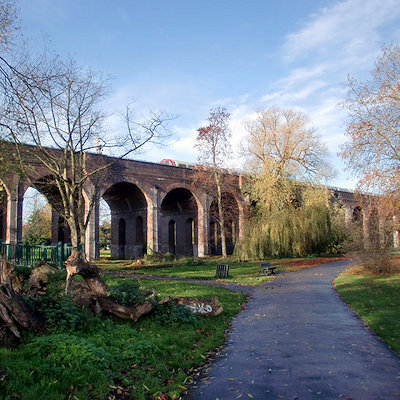
One of the main features of Arnos Grove is Arnos Park - 44 acres or 18ha in size. Arnos Park is a remnant of the Arnos Grove estate, and was opened in 1928 after having been purchased by Southgate Council. The Pymmes Brook flows through the park, which contains diverse woodland but is mostly grassy fields. A large brick viaduct, with 34 numbered arches, carries the Piccadilly line beyond Arnos Grove tube station towards Southgate through the western end of the park. The park contains a large playground for children as well as several tennis courts. The Pymmes Brook Trail passes through the park. Also, evidence of the abandoned New River loop can be found within the trees in the north side of the park.
|