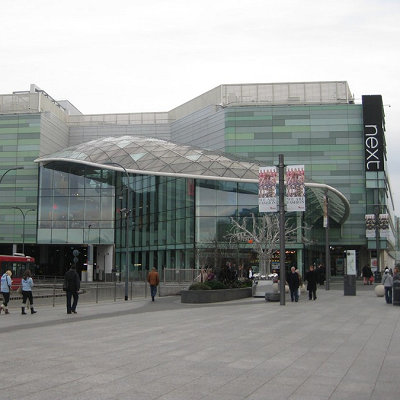
White City is a district in the London Borough of Hammersmith and Fulham and forms the northern part of Shepherd's Bush. Today, White City is home to football club, Queens Park Rangers FC.
The area now called White City was level arable farmfields until 1908, when it was used as the site of the Franco-British Exhibition and the 1908 Summer Olympics. In 1909 the exhibition site hosted the Imperial International Exhibition and in 1910, the Japan-British Exhibition. The final two exhibitions to be held there were the Latin-British Exhibition (1912) and the Anglo-American Exhibition (1914), which was brought to a premature end by the outbreak of the First World War. During this period it was known as the Great White City due to the white marble cladding used on the exhibition pavilions, and hence gave its name to this part of Shepherd's Bush.
The White City Stadium in the north of the area, known as the Great Stadium and seating 66000, was officially opened by King Edward VII on 27 April 1908 for the Olympics. After the Olympics, it continued to be used for athletics until 1914, and was later turned into a greyhound racing track, although it was also used for short periods by Queens Park Rangers football club, and for other sports. In 1931, a 440yd running track was installed for the Amateur Athletic Association Championships, held there from 1932 to 1970. It hosted one match during the 1966 World Cup. The stadium was demolished in 1985 to make way for the BBC White City building. Today, the 1908 Olympics are commemorated with a list of athletes inscribed on the side of the BBC Broadcast Centre Building, and the athletics finish line is marked in the paving outside the building.
The Marathon from these London Olympics played an important part in the development of the modern marathon race. In the early years of competitive international sport, the long distance marathon race did not have a standard set distance. The distance run at the first seven Olympics from 1896 to 1920 varied between 40km and 42.75 km. The starting point of the race at the 1908 Olympics was at Windsor Castle creating a distance of 26 miles 385 yards (42.195 km) to the finishing line at White City stadium. In 1921 this was adopted as the standard distance.
To house the growing population of Shepherd's Bush, a five-storey housing estate was built in the late 1930s, which also took the name of the White City. Streets were named after countries that had featured in the exhibitions.
In 2001, BBC Television Centre was damaged by a car bomb attack by the Real IRA. The bomb went off on Wood Lane, in front of the Television Centre news building.
On 30 October 2008, Westfield shopping centre was opened. Westfield Group (with Hausinvest Europa) has built a new shopping centre, bounded by the West Cross Route (A3220, formerly the M41 motorway), the Westway (A40) and Wood Lane (A219). This centre has been branded "Westfield London".
Two stations were built to serve the centre close to the sites of closed former London Underground stations:
Wood Lane on the Circle line and the Hammersmith & City line, located to provide a walking distance connection with the Central line station at White City. Shepherd's Bush on the West London Line, to the east of the site adjacent to the Holland Park roundabout and served by London Overground trains. It is also a short walking distance from Shepherd's Bush tube station served by the Central line.
In 2007, it was announced that the BBC would sell its landmark Television Centre as part of a cost-cutting programme.
In 2008 English Heritage announced its recommendation to list parts of TV centre as an excellent example of 20th-century architecture.
Following the sale of the Television Centre, White City has become a key regeneration area within Central London. A strong partnership between White City Living by St James, Westfield London, Stanhope and Imperial College London, has created a vision for the future of White City area. The regeneration project will deliver 5000+ high quality new homes, 2 million sq ft of commercial office space, 30 acres of public space, 19,000 jobs and Westfield London has become the largest shopping centre in Western Europe, with over 400 stores, multiple cinema screens, restaurants, bars and cafes.
|