
Like us on Facebook
PLACE NAMES


|
|
Harmondsworth
|
| |
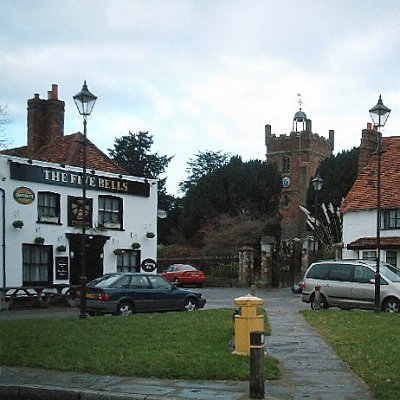
Harmondsworth is a village in the London Borough of Hillingdon in the county of Greater London with a short border to the south onto London Heathrow Airport and close to the Berkshire county border. The village has no railway stations, but adjoins the M4 motorway and the A4 road (the Bath Road). Harmondsworth was in the historic county of Middlesex until 1965. It is an ancient parish that once included the large hamlets of Heathrow, Longford and Sipson. Longford and Sipson have modern signposts and facilities as separate villages, remaining to a degree interdependent such as for schooling. The Great Barn and parish church are medieval buildings in the village. The largest proportion of land in commercial use is related to air transport and hospitality. The village includes public parkland with footpaths and abuts the River Colne and biodiverse land in its Regional Park to the west, once the grazing meadows and woodlands used for hogs of Colnbrook.
The west of the parish has two major airline headquarters (international and local) and two immigration detention centres: the larger is for a maximum of 620 men without leave (permission) to enter or remain in the United Kingdom. Many international visitors stay within the church-based bounds of Harmondsworth, as all hotels are branded as "Heathrow", a former hamlet and other farmsteads that were absorbed by the airport.
In October 2016 it was announced by HM Government that Heathrow Airport would receive permission to apply for a third runway. According to current expansion plans, around half of the existing village of Harmondsworth will have to be demolished to make way for the north-west runway and surrounding grass safety area. The other half, including the parish church and Great Barn, will be only a few metres from the airport perimeter.
Harmondsworth remains an ecclesiastical parish, with the name first recorded in AD 780 when King Offa granted land to his servant Aeldred.
Before 1066 the manor was owned by Harold Godwinson (Earl Harold), and at the Conquest (1066) it passed to William I. In 1069 it was granted by the king, on the suggestion of William FitzOsbern, 1st Earl of Hereford (c. 1020 - 1071), to the Benedictine Abbey of Holy Trinity, Rouen, afterwards known as St. Catherine's, which held it in 1086 and then until 1391.
In 1547 the lordship and manor was granted to William Paget, 1st Baron Paget, KG, PC. The Pagets held on to the manor until the eighteenth century, selling most of early during the time of the heir of Henry Paget, 2nd Earl of Uxbridge (1719-1769), Henry Bayley-Paget, 1st Earl of Uxbridge (1744-1812). William, Lord Paget (1609-1678) sold some of it in 1672. Via his daughter Penelope Foley the Pagets were ancestors of Charles Darwin.
Harmondsworth as an ancient parish of 30 hides (as assessed at Domesday, 1086) or 3,480 acres (14.1 km²) (rather than today's surviving village nucleus) changed from agrarian and a few, isolated London suburban homes to mostly industrial gradually in 1929 with the opening of the Colnbrook by-pass which by-passed diminutive Longford to the north.
Harmondsworth civil parish from its 1880s creation until its 1964 abolition contained the same areas as its religious counterpart. Industrial development began in 1930 with the opening of the Road Research Laboratory (RRL) on this road. In the same year, the Fairey Aviation Company opened an airfield, the Great West Aerodrome, south-west of Heathrow. This formed the nucleus of the later airport, and the Fairey hangar was eventually incorporated into Heathrow Airport as a fire station.
By the late 1930s some residential building had taken place, although almost entirely in the northern half of the parish. Small estates were built off Hatch Lane around Candover Close and Zealand Avenue and further building took place along Sipson Road, around Blunts Avenue, and along the north side of the Bath Road at Sipson Green. Longford remained virtually untouched. A brick-works was established by the corner of Cain's Lane and Heathrow Road and the area of former heathland was extensively worked for gravel, sand, and grit. In the 1930s Middlesex County Council opened a large sewage pumping station to the west of Perry Oaks, which was converted to Heathrow Terminal 5 in the early 21st century. The Great South West Road touched the south-east corner of the parish but played no part in its development. Although many of the orchards survived, their numbers had been greatly reduced and it seems probable that much of the former fruit-growing area was being used for market gardening. In 1944 Harmondsworth and Sipson retained their agricultural character despite some suburban housing. It was then suggested that further expansion in the Yiewsley and West Drayton area should be curtailed, as the land was primarily in demand for agriculture, which was greatly adhered to until 1971.
In 1944, however, the modern pattern of Harmondsworth began to emerge with the transfer of the Fairey airfield to the Royal Air Force and its subsequent development by the Air Ministry as Heathrow R.A.F. station. This entailed the complete demolition of Heathrow and Perry Oaks hamlets, and widespread draining of the old flooded gravel pits. Many of the small buildings along the south side of the Bath Road that were still standing in 1960 were erected by the R.A.F.
Although not a post town, in printed form Harmondsworth is frequently seen in books. From 1937 the offices and warehouses of Penguin Books were here until their gradual closure in the 1990s. In this period its books published in the country bore the publication location, "Harmondsworth, Middlesex".
In 1965 it became part of the London Borough of Hillingdon in the newly formed ceremonial county of Greater London.
|
 Feel free to Email me any additions or corrections Feel free to Email me any additions or corrections
LINKS AVAILABLE TO YOUR SITE
| |


