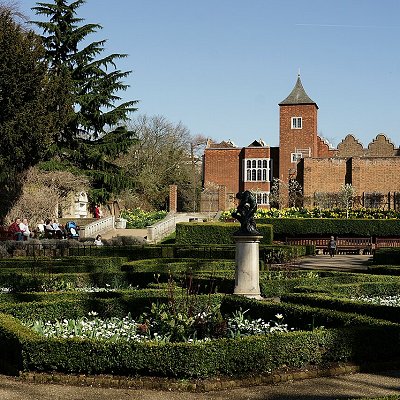
Holland Park is an area of Kensington, on the western edge of Central London, that lies within the Royal Borough of Kensington and Chelsea and largely surrounds its namesake park, Holland Park.
Holland Park contains some of the most expensive residential streets in London and the United Kingdom, including Addison Road, Holland Villas Road and Ilchester Place. Past and present residents include Sir David and Victoria Beckham, Sir Elton John, David Cameron, Ed Sheeran, Sir Richard Branson, and Robbie Williams, among others. The small neighbourhood is further home to the embassies of several countries, including Azerbaijan, Ukraine, Greece, Jordan, Russia and Lebanon.
The area is principally composed of tree-lined streets with large Victorian mansions and cultural tourist attractions such as the Design Museum and Leighton House, luxury spas, hotels, and restaurants along Holland Park Avenue and Kensington High Street.
Holland Park is located between Notting Hill and South Kensington, west of Kensington Gardens and Hyde Park. While there are no official boundaries, the Holland Ward was historically bounded by Kensington High Street to the south, Holland Road to the west, Holland Park Avenue to the north, and Kensington Palace Gardens to the east.
/p>
Adjacent districts are Notting Hill to the north, Earl's Court to the south, and Shepherd's Bush to the west.
The district was rural until the 19th century, and most of the area now referred to by the name Holland Park was formerly the grounds of a Jacobean mansion called Cope Castle, which today is known as Holland House. In the later decades of that century the owners of the house sold off the more outlying parts of its grounds for residential development, and the district which evolved took its name from the house. Large parts of Holland Park were constructed between 1860 and 1880 by master builders William and Francis Radford, who were contracted to build over 200 houses in the area. Notable 19th-century residential developments in the area include the Royal Crescent and Aubrey House. It also included some small areas around the fringes which had never been part of the grounds of Holland House, notably the Phillimore Estate (there are at least four roads with the word Phillimore in their name) and the Campden Hill Square area.
In the late 19th century, a number of notable artists and art collectors (including Frederic Leighton, P.R.A. and Val Prinsep), known as the Holland Park Circle, lived in the area, especially in Melbury Road and Holland Park Road.
Lansdowne House, at Lansdowne Road. is a Grade II listed eight-storey building which was originally constructed in 1902-04 by the Scottish architect William Flockhart, for the South African mining magnate Sir Edmund Davis. The building contained apartments and artists' workshops. Among the artists who had studios in the building in the early decades of the 20th century were Charles Ricketts, Charles Haslewood Shannon, Glyn Philpot, Vivian Forbes, James Pryde, and Frederick Cayley Robinson, who are commemorated on a blue plaque on the building.
The building underwent significant alterations. When, in 1957, the record producer Denis Preston was looking for a property in which to set up a recording studio, his assistant engineer Joe Meek found the premises, which had unusually high ceilings and a basement squash court, suitable for conversion into a studio. Preston, Meek and (a year later) the engineer Adrian Kerridge then established the studio, and made their first recordings there in 1958. The studio was London's first independent music recording studio. In 1962 an enlarged control room overlooking the studio floor was opened. Kerridge later became the studio's owner. The studios closed in 2006 and the building was subsequently converted into 13 self-contained apartments, while retaining a small recording studio.
|