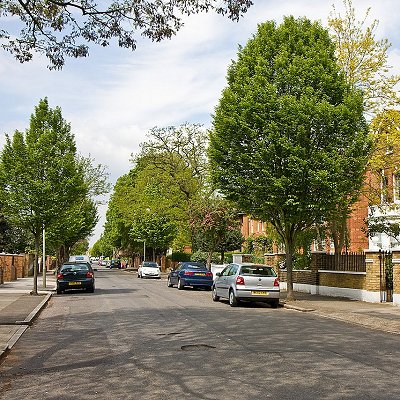
Grove Park is an area in the south of Chiswick, now in the borough of Hounslow, West London. It lies in the meander of the Thames occupied by Duke's Meadows park. Historically, the area belonged to one of the four historic villages in modern Chiswick, Little Sutton. It was long protected from building by the regular flooding of the low-lying land by the River Thames, remaining as orchards, open fields, and riverside marshland until the 1880s. Development was stimulated by the arrival of the railway in 1849; Grove Park Hotel followed in 1867, soon followed by housing. In the Second World War, the first successful V-2 rocket attack on Britain took place in Staveley Road during September 1944.
The architecture of the area includes houses in British Queen Anne Revival style, while the station building is Italianate. The 1872 neo-Gothic St Paul's Church is built in irregular blocks of stone. It has a small fleche instead of a spire, as well as an apse at its eastern end. St Michael's Church was designed by W. D. Caröe and Herbert Passmore in 1908 in a domestic style in buttressed red brick with tiled arches and with dormer windows in its roof, while the windows use neo-Gothic stone tracery.
Famous former residents of Grove Park include the actor John Thaw, the soldier Bernard Montgomery, and the poet Dylan Thomas. St Paul's vicarage has repeatedly been used as a film set, including in Tinker Tailor Soldier Spy, Killing Eve, Lewis, Grantchester, and The Theory of Everything.
Much of Grove Park was still rural until late in the 19th century; the risk of flooding from the tidal Thames protected it from building. One of the four constituent villages of Chiswick, Little Sutton, was in the Grove Park area, about the centre of the parish of Chiswick at that time; two other villages, Strand-on-the-Green and Old Chiswick, lie just to the west and to the east of Grove Park, respectively, with Turnham Green to the north.
A house stood on the site of Grove House from 1412; it was replaced by 1705 with, according to a contemporary observer, "a spacious regular modern building ... pleasantly situated by the Thames side. Behind it are gardens by some said to be the finest in England". Grove House was owned by the Barker family at that time; from 1745 it belonged to the Earl of Grantham and then to an eccentric animal-lover, Humphrey Morice. The Duke of Devonshire bought the whole estate in the 1840s, reshaping Grove House without its third storey, and letting it to tenants.
The building of the railways including Chiswick railway station in 1849 spurred development. Grove Park Hotel was built in 1867, soon followed by housing. Growth was slow but steady, with residential development accompanied by small-scale industry such as soap making.
Robert William Shipway bought Grove House in the 1890s; it was demolished in 1928 and replaced by the houses on the west side of Kinnaird Avenue.
|