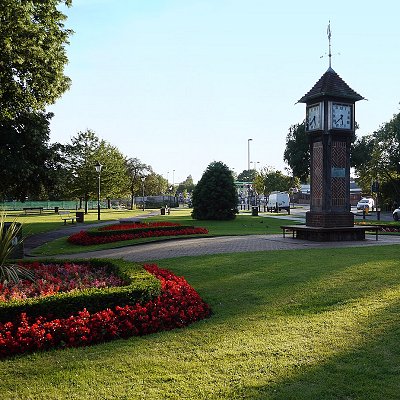
Northolt is a town in West London, England, spread across both sides of the A40 trunk road. It is 11 mi (17.7 km) west-northwest of Charing Cross and is one of the seven major towns that make up the London Borough of Ealing. It had a population of 30,304 at the 2011 UK census.
The earliest record of Northolt is in 872 as the Anglo Saxon norð healum, where norð is North and healum (or hale) is a nook, corner, or retreat. By 1610, the Name Northolt appears, with in this case, holt having no relationship with 'wood', but an evolution of hala, hale, hal, hall, halle and holt.
Archaeological evidence suggests that the settlement's origin was an 8th-century Saxon village close to Northolt Manor behind the present Court Farm Road. It is mentioned in the Domesday Book as Northala, part of the Elthorne Hundred in the historic county of Middlesex, England. In 1066 the lord was Esger the constable, and in 1086 was Geoffrey de Mandeville. Northolt Manor itself was built in the fourteenth century and provides much of the archeological information of the area from its excavations in the 1950s and onward. A Tudor barn built in 1595 from Smith's farm in Northolt was moved to Chiltern Open Air Museum and is now on display there. In the early part of the 18th century farmland was enclosed in order to provide hay for the City of London, alongside more traditional crops such as peas and beans. Up to late Victorian times, the area was rural with predominantly arable crops being grown.
1795 saw parliamentary approval for construction of Paddington Arm of the Grand Junction Canal later becoming part of the Grand Union Canal. The route from Hayes to Paddington passes through Northolt, opening on 10 July 1801. The Great Central Railway line (now the Chiltern Line) opened in 1906, passing through Northolt on its way from Marylebone to High Wycombe. However, it wasn't until 1926 that a station opened at Northolt Park. 1906 also saw the Great Western Railway's New North Main Line pass through south of Great Central Railway on its way to Birmingham. The following year Northolt Halt opened on it, eventually becoming Northolt station. In 1948 an extension to the Central line, transformed it into Northolt tube station.
In May 1915 the Royal Flighing Corp established an airfield in neighbouring South Ruislip in the London Borough of Hillingdon, Most early RAF airfields were named after the nearest railway station; in this case Northolt Junction, (now South Ruislip), so it became RAF Northolt.
WW1 also brought an urgent need for more munitions, and in 1915 the Ministry of Munitions created many national munition factories. The National Filling Factory No 7 in Hayes, Middlesex had an explosives magazine at Northolt which was completed late in 1916. This 93-acre site had 20 stores, each able to hold 100 tons of explosives, and was connected by a rail spur at Northolt Junction station. The location was just north-east of the current Ruislip Gardens station, with the rail spur on the south side of Yeading Brook, and the magazines connected by trolleyways on the north side. About 100 tons of explosives per day were sent by rail to Hayes for filling artillery shells - both the Hayes factory and the magazine were removed after the war ended.
Suburban development began in the 1920s. Most of the housing north of the Western Avenue was built in the 1920s-1930s, and is in the private housing sector. Most of the housing built to the south of the Western Avenue was built in the 1960s-1970s, and is in the social housing sectors, particularly along the Kensington and Ruislip Roads.
Two important transport links run through Northolt: the Paddington Arm of the Grand Union Canal and the modern A40 road.
In the 21st century, a new large private housing development was built on the former site of the Taylor Woodrow company, adjacent to the Grand Union Canal. This development is known as "Grand Union Village" and incorporates a new canal boat marina.
St Mary the Virgin church (13th century) stands on the hill overlooking the old village. The Welsh poet Goronwy Owen was briefly a curate here. Bishop Samuel Lisle is buried here. In the centre of the village is a freestanding clock tower erected to commemorate the coronation of George VI in 1937.
The White Hart public house is on the site of an old coaching inn. The roundabout immediately south of it is on the junction of the A312 (Church Road and Hayes Bypass) with the A4180 (Ruislip Road and West End Road). The Yeading Lane also joins the roundabout. (Now closed)
Willow Cottages on the village green are said to have been built of bricks from the old manor house, which once stood behind the parish church.
The two towers of the disused RAF radio station north of the town are situated in the Wood End wireless station recreation ground, which is bordered on all sides by housing (Bayshill Rise, Lancaster Road, Blenheim road). The location is now home to a National Air Traffic Control base.
Northala Fields is a large area alongside the A40 road which has been redeveloped as an extension to the Northolt and Greenford Country Park. The development consists of four large, man-made conical hills (built of rubble from the first Wembley Stadium), which act as a sound barrier to block traffic noise from the Western Avenue. Behind the mounds are new ponds and a visitor centre.
The Larkspur Rovers F.C. clubhouse is in Rowdell Road, Northolt. It received funding from Ealing Council and an Olympic legacy grant of £50,000 from Sport England's Inspired Facilities Fund.
There is a village community centre building in Ealing Road, opposite St Mary's church, which incorporates an open-air miniature railway.
A leisure centre, incorporating a pool, a fitness centre, a community hall and a library was built on the site of the former Swimarama swimming pool at the junction of Mandeville Road and Eastcote Lane North, and opened in 2010.
|