Hanworth is a district of West London, England. Historically in Middlesex, it has been part of the London Borough of Hounslow since 1965. Hanworth adjoins Feltham to the northwest, Twickenham to the northeast and Hampton to the southeast, with Sunbury-on-Thames to the southwest.
The name is thought to come from the Anglo-Saxon words haen/han and worth, meaning "small homestead".
During Edward the Confessor's time, Hanworth was a sparsely populated manor and parish held by Ulf, a "huscarl" of the King. Huscarls were the bodyguards of Scandinavian Kings and were often the only professional soldiers in the Kingdom. The majority of huscarls in the kingdom were killed at Hastings in 1066, and William the Conqueror granted Hanworth to Robert under Roger de Montgomery, the Earl of Arundel and Shrewsbury. After his death, his second son held the land until his death in the Mowbray conspiracy of 1098, after which it passed to his eldest son, Robert de Bellesme, who also rebelled against the Crown in 1102 with the result that the lands were confiscated.
Towards the end of the 14th century, the manor was occupied by Sir Nicholas Brembre, who was Mayor of London in 1377 and 1378. Sir Nicholas was hanged at Tyburn in 1387, having been accused of treason.
In 1512, Hanworth came to the Crown, and Henry VIII, who enjoyed hunting on the heath surrounding the village, gave the manor to Anne Boleyn for life. After her execution, the manor returned to the King who held it until his death in 1547 but passing to Katherine Parr, who lived in the house with her stepdaughter Princess Elizabeth. When the princess became Queen, she stayed at Hanworth Manor several times, often hunting on the heath.
In June 1544, when her sister Anne Parr had a baby, Queen Katherine Parr offered her sister the use of her own manor at Hanworth for the childbirth. The Queen frequently dispatched messengers to Hanworth to check on her sister's well-being and arranged for a sisable group from her household to attend the baby's christening. By July, there were still exchanges of messages between the Queen in London and her sister at Hanworth. Shortly thereafter, Anne made the short journey to the Hertfords' new residence, Syon House, to visit Anne Stanhope, Countess of Hertford, and her newborn.
In 1784, General Sir William Roy, the military draughtsman, supervised the Principal Triangulation of Great Britain project. That measured a base line from King's Arbour, across Hounslow Heath passing through Hanworth Park, to Hampton Poor House. This measurement, which earned the General the Copley medal of the Royal Society, was the origin of all subsequent surveys of the United Kingdom, and still forms the basis of the Ordnance Survey maps today.
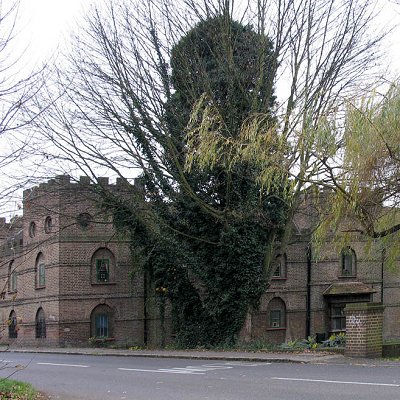
In 1797, the manor house was destroyed by fire, leaving only the stable block, which survives today as flats, and the coach house, which was converted into homes. c. 1799 a new house was built on the same site known as Hanworth House. In 1827 the house and estate of c. 680 acres (known as Hanworth Great Park), including three farms was sold outright to Henry Perkins. During the 1830s the current building known as Hanworth Park House was built. This building is currently sitting derelict in the middle of Hanworth Park. A local campaign is running to restore the house.
By the end of the 19th century, William Whiteley, of Whiteleys in Bayswater, had bought 200 acres of farmland that had previously been Butts and Glebe farms. Renamed Hanworth Farms, these supplied all the produce for the store's food hall having been transported daily by horse and cart. Following Whiteley's murder by his illegitimate son in 1907, his legitimate sons sold the farm to a jam manufacturer who operated there until selling the land for new homes in 1933.
|