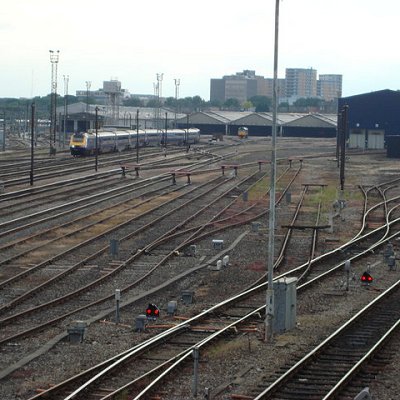
Old Oak Common is a semi-industrial area of London, between Harlesden and Acton. The area is traditionally known for its railway depots, particularly Old Oak Common TMD which was decommissioned in 2021. Together with neighbouring Park Royal, the area is intended to become the UK's largest regeneration scheme.
Old Oak Common has been in the London Borough of Hammersmith and Fulham since 1994. Further south lies an open area, Wormwood Scrubs Park, and Wormwood Scrubs prison. To the north it is bounded by the Grand Union Canal and across it lies Willesden Junction station.
Originally, Old Oak Common was a stretch of land defined by what became the Harrow Road at its northern end, and its eastern edge was the northern source of Stamford Brook, forming a boundary with Wormwood Scrubs. By 1801, the Paddington Canal had cut it in half, further reducing its size.
The Great Western Railway's Great Western Main Line (GWML) of 1838-1841 from London Paddington to Bristol and the 1903 Acton-Northolt line to the Great Western and Great Central Joint Railway at Northolt divided at Old Oak junction.
Before 1965, Old Oak Common formed part of the Municipal Borough of Acton, and the area thus became part of the London Borough of Ealing that year. Following a revision of municipal boundaries in 1994, Old Oak Common was transferred from Ealing to Hammersmith and Fulham.
The partially singled Acton-Northolt line closed in December 2018 to allow for the construction of Old Oak Common railway station, which will offer interchange between GWML trains, the Elizabeth line and the High Speed 2 (HS2) line heading north. Additional rail interchanges may be provided with the construction of two new London Overground stations, Hythe Road on the West London line and Old Oak Common Lane on the North London line.
In summer 2011, the London Borough of Hammersmith and Fulham launched a wide-ranging 'Park Royal City' plan for Old Oak Common, including the proposed station, and with light-rail lines to the surrounding areas.
|