|
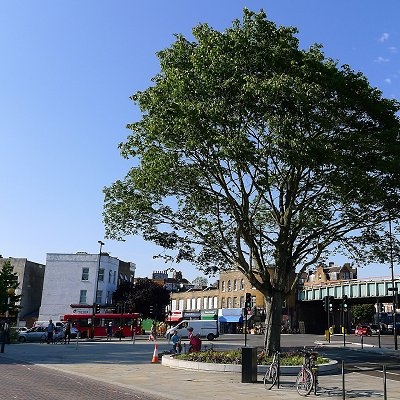
Herne Hill is a district in South London, approximately four miles from Charing Cross and bordered by Brixton, Camberwell, Dulwich, and Tulse Hill. It sits to the north and east of Brockwell Park and straddles the boundary between the boroughs of Lambeth and Southwark. There is a road of the same name in the area (which is part of the A215), as well as a railway station.
In Rocque's 1746 map, the area is shown as "Island Green", probably reflecting the presence of the River Effra and smaller tributaries. Early references to the area also use the form "Ireland Green".
The earliest documented reference to "Herne Hill" is in two fire insurance policies issued by the Sun Insurance Company in 1792 (where the spelling is "Hearns" and "Herns" Hill).
The area now known as Herne Hill was part of the Manor of Milkwell, which existed from at least 1291, and was a mixture of farms and woodland until the late 18th century. It was divided between the ancient parishes of Camberwell and Lambeth.
In 1783, Samuel Sanders (a timber merchant) bought the land now occupied by Denmark Hill and Herne Hill from the Manor; he then began granting leases for large plots of land to wealthy families.
By the mid-19th century, the road from the modern Herne Hill Junction to Denmark Hill was lined with substantial villas set in spacious grounds and the area had become a prosperous suburb for the merchant class. (John Ruskin grew up, from the age of 4, in a house on Herne Hill, until moving in 1842 to a large villa on Denmark Hill).
Herne Hill was transformed by the arrival of the London, Chatham & Dover Railway in 1862. Cheap and convenient access to London Victoria, the City of London, Kent and south-west London created demand for middle-class housing; the terraced streets that now characterise the area were constructed in the decades after the opening of Herne Hill station and the old estates were entirely built over.
During World War II five V-1 flying bombs fell at various sites in the Herne Hill area, causing six deaths.
During the early morning of 7 August 2013, an 88-year-old 0.9 m diameter water main on Half Moon Lane burst, flooding Herne Hill, Dulwich Road and Norwood Road along with 36 properties (including the Half Moon public house) to create a scene described as "biblical" by local residents. Thames Water admitted liability and estimated the total cost of the damage to be around £4 million. The Half Moon reopened in March 2017, following a vigorous local campaign to save it as a pub; Southwark Council has designated it an asset of community value.
Brockwell Park: The area is home to the 50.8 ha (125.5 acres) Brockwell Park. Near a hilltop in Brockwell Park stands the Grade II* listed Brockwell Hall, which was built in 1811-13 to the design of the architect David Riddall Roper. The hall and the land surrounding it were opened to the public in 1891 after being purchased by London County Council. Brockwell Park hosts the annual Lambeth Country Show and was the site of London's Gay Pride festival for several years in the 1990s. The park also houses Brockwell Lido, a 1937 open-air swimming-pool that faces on to Dulwich Road, Grade II listed in 2003.
Herne Hill railway station on Railton Road was opened by the London, Chatham and Dover Railway in 1862; the Gothic, polychrome brick[14] station building was Grade II listed in 1998. The associated railway viaduct and bridges are also noteworthy; The Building News stated in 1863 that the viaduct was "one of the most ornamental pieces of work we have ever seen attempted on a railway" for its fine brickwork.
Herne Hill Velodrome: The Herne Hill Velodrome, situated in a park off Burbage Road, was built in 1891 and hosted the track cycling events in the 1948 Summer Olympics. Unlike most modern, steeply-banked velodromes, it is a shallow concrete bowl; as of 2010 the 'Save the Herne Hill Velodrome' campaign was seeking a way to secure the future of the site. The same park also has a football pitch and was the home of Crystal Palace F.C. from 1915 until 1918.
A Blue plaque at 84 Burbage Road marks the former home of the athletics coach Sam Mussabini. In 1894, Mussabini was appointed coach to the Dunlop cycling team which trained at the Herne Hill Velodrome. In 1913, Mussabini was appointed coach to the Polytechnic Harriers at the Herne Hill athletics track, which ran round the inside of the Velodrome cycle track. Here he trained athletes, including the fourteen-year-old Harold Abrahams. Mussabini was later immortalised in the film Chariots of Fire, in which he was played by actor Ian Holm.
In recognition of the historical importance and specialist character of the area within its urban context, Stradella Road was designated as a conservation area, by Southwark Council in 2000, under the Civic Amenities Act of 1967. The conservation area consists principally of properties in Stradella and Winterbrook Roads and also includes bordering properties in Burbage Road and Half Moon Lane.
|