|
Charlton is an area of southeast London, England, in the Royal Borough of Greenwich. It is east of Greenwich and west of Woolwich, on the south bank of the River Thames, 7.2 miles (11.6 km) southeast of Charing Cross. An ancient parish in the county of Kent, it became part of the metropolitan area of London in 1855 and is home to Charlton Athletic and Charlton House.
Charlton is recorded in the 1086 Domesday Book as Cerletone. It is formed from Old English 'ceorl' and 'tun' and means 'farmstead of the freemen or peasants'. It is a common English placename and the parish was also known as Charlton next Woolwich to distinguish it from Charlton by Dover. During the 19th century the riverside portion of the area became known as New Charlton.
Charlton is assessed in the Domesday Book of 1086 at one "sulung", which is commonly held to have been the equivalent of two hides. In 1086 it was in the fee of Gundulf, bishop of Rochester, but in 1066 it had been held from the king as two estates, by two brothers, named Godwine and Alweard. Though assessed at only one sulung, it had a slightly higher value than might be expected, at £7, both in 1066 and in 1086. A church dedicated to St Luke is recorded in the village as early as 1077, although no trace of the medieval building survives.
In 1093, the manor of Charlton was given to Bermondsey Abbey by Bishop Robert Bloet of Lincoln. In 1268, the Abbey was granted a Monday market at Charlton, as well as an annual fair of three days, centred on Trinity Sunday, the eighth Sunday after Easter.
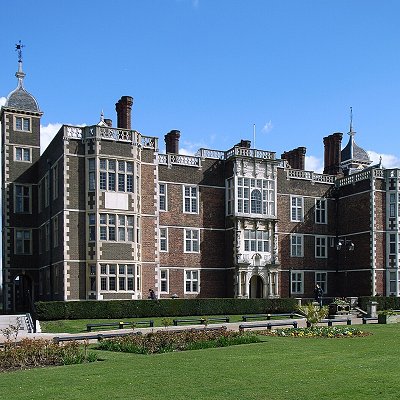
Between 1607 and 1612, Sir Adam Newton, tutor to Prince Henry, eldest son of James I, had a new manor house, Charlton House, built in the village. The Jacobean mansion by architect John Thorpe was never used by the prince, who died in 1612. On the northern edge of the house's garden is a mulberry tree planted in 1608 by order of King James in an effort to cultivate silkworms. On the death of Sir Adam, his executors Peter Newton and David Cunningham of Auchenharvie were charged to rebuild St Luke's Church.
The manor was subsequently acquired by the colonial administrator Sir William Langhorne, 1st Baronet, who is buried in the parish church. Upon his death without issue in 1715, his possessions in Charlton and Hampstead passed to the Conyers baronets, and subsequently to the Maryon-Wilson baronets.
In the early 18th century, Charlton was described by Daniel Defoe as: "a village famous, or rather infamous for the yearly collected rabble of mad-people, at Horn-Fair; the rudeness of which I cannot but think, is such as ought to be suppressed, and indeed in a civiliz'd well govern'd nation, it may well be said to be unsufferable. The mob indeed at that time take all kinds of liberties, and the women are especially impudent for that day; as if it was a day that justify'd the giving themselves a loose to all manner of indecency and immodesty, without any reproach, or without suffering the censure which such behaviour would deserve at another time." (from A Tour through Great Britain)
The Horn Fair (or Charlton Fair) was held regularly on 18 October each year, and retained its reputation for lawlessness; in 1833, for example, police arrested a swindler who had cheated several artillerymen. In 1857, following the abolition of nearby Greenwich Fair, Charlton Fair was described in the Morning Chronicle as "more like a carnival of the very worst and most vulgar class than any fair in the country." The Horn Fair was abolished, along with the livestock fairs of nearby Blackheath, by order of Henry Austin Bruce, the reforming Home Secretary, in 1872.
In the early nineteenth century, Spencer Perceval, the only British Prime Minister to be assassinated, was buried at St Luke's church; Perceval's wife having been a member of the Maryon-Wilson family. In 1843, Charlton was the site of the death and burial of murdered civil servant Edward Drummond, whose assassination led to the establishment of the M'Naghten Rules for legal insanity.
The flat land adjoining the Thames at Charlton Riverside has been a significant industrial area since Victorian times. The establishment of heavy industry centred on Charlton Pier, and led to a number of serious fires in the area in the mid 19th century. A notable establishment was the Siemens Brothers Telegraph Works (although largely in the parish of Woolwich) opened in 1863, which manufactured two new transatlantic cables in the 1880s, and contributed to PLUTO in World War 2.[13] It was in this industrialised area that Charlton Athletic F.C. was established in 1905, before moving a short distance to The Valley in 1919.
From 1903 to 1913, the Italian writer Italo Svevo lived in a house on Charlton Church Lane which now bears a blue plaque in his honour. He had arrived there in his capacity as a director in a Trieste firm selling high-quality underwater paint for ships, on whose behalf he established a factory in Charlton's Anchor and Hope Lane, fulfilling a big contract with the British Royal Navy.
The non-ferrous foundry of J. Stone & Co moved to Charlton from Deptford in 1917, and produced 22,000 propellers for the Royal Navy during World War II (its products being fitted to battleships, aircraft carriers, cruisers and numerous smaller vessels), plus propellers and water-tight doors for RMS Queen Mary, RMS Queen Elizabeth and Royal Yacht Britannia. In 1963 Stone's marine propeller business merged with Manganese Bronze (also originally founded in Deptford, in 1882, before relocating to Millwall and then Birkenhead in 1941) and manufacture moved to Birkenhead. Stone Foundries still operates at Charlton, in a plant established in 1939 to produce aluminium and magnesium light alloy castings mainly for the aircraft industry, and production of nails and rivets continues at nearby Stone Fasteners.
The estates surrounding Charlton House were gradually broken up, and once the Maryon-Wilson family died out in 1925, the surviving open spaces were converted into public parks, two of which bear the family name. The house itself became the property of the local authority (currently the Royal Borough of Greenwich) and is used as a library and community centre. Maryon Park was used as the filming location for the pivotal murder scene in Michelangelo Antonioni's film Blow-Up (1966).
|