|
Harlesden is a district in the London Borough of Brent, north-west London.
Located north of the Grand Union Canal and Wormwood Scrubs, the Harrow Road flows through the centre of the area which goes eastwards to Central London and west towards Wembley. Harlesden was historically in the Municipal Borough of Willesden before the creation of Brent; it lies within Willesden's postal district of NW10. Harlesden has been praised for its vibrant Caribbean culture and unofficially named London's reggae capital for its contributions to the musical genre. The town centre contains a large number of multicultural independent businesses, while industry exists by the canal, most notably a McVitie's biscuit factory that has been operating since 1902. The population includes people of Afro-Caribbean heritage most notably, as well as Irish, Portuguese, Brazilian, Somali, and smaller Latin American and East African groups within the community.
Harlesden was once a Saxon settlement. The Domesday Book calls it "Hervlvestvne". For centuries the area was a small rural community set in orchards with some inns.
In the 19th century, Harlesden, then a rural village in the parish of Willesden, began to develop some of its urban appearance with the arrival of the railways. Willesden Junction, Kensal Green and Harlesden stations on the London & Birmingham Railway all had an effect on the developing village. Cottages for railway and industrial workers were built, as was grander housing for the local middle class. The London–Harrow coach passed through the village every day by 1839. The village gained a blacksmith, grocer and a shoemaker during this period.
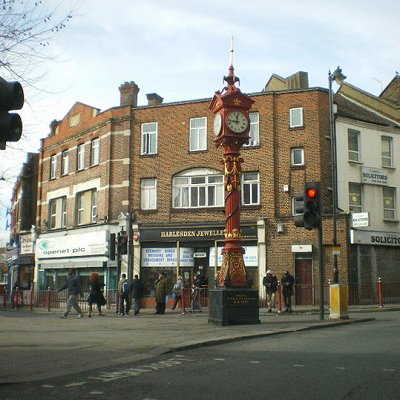
Harlesden increasingly lost its rural nature, with factories replacing farms and woodland. Sewerage arrived here in 1871 and soon houses were being built. A mainly middle class population resided here who enjoyed the availability of numerous churches, cinemas, a court, a library and recreational pleasure at Roundwood Park. From late Victorian times until the 1930s, housing completed its spread across the area, and Harlesden became part of the London conurbation. A jubilee clock tower was built in 1888. Harlesden gained excellent transport links by the train stations as well as a frequent horse bus service to Paddington as early as 1890. Electric trams came to Harlesden in 1907. That year also saw the opening of Willesden Hippodrome Theatre, which was destroyed by German bombing in 1940. Much of the working class in Harlesden suffered from poverty, with the Willesden Chronicle mentioning "nearness to starvation" of those people in 1908.
In 1908, the Olympic Games were held in London. The marathon race course went through Harlesden, and ended at the White City Stadium. The course entered Harlesden via Craven Park Road, turned down Manor Park Road, down the High Street and passed the Jubilee Clock. After that, the course headed towards North Acton via Station Road and passing Willesden Junction.
Mainly after World War I, one of Europe's biggest industrial estates was constructed at nearby Park Royal, and large factories there and within Harlesden included McVitie & Price (later United Biscuits) from 1910, and Heinz from 1919. Industrial growth led to a middle class exodus as Harlesden turned entirely into a working class area in the inter-war period. The McVitie & Price factory became the largest biscuit factory in the western world, employing 2,600 people by 1978.
By 1939 the last of the really large Victorian houses, Roundwood House and Knowles Tower, had both been demolished by Willesden Council. At 6am on 16 January 1939, the Irish Republican Army blew up the Harlesden electricity cable bridge. The bridge crossed the Grand Junction Canal, and carried the power line from Battersea Power Station. No one was injured in the attack. In the interwar period, a cargo ship, built on Tyneside, was named after the area. In 1941, the ship was sunk by the German battle cruiser Gneisenau, approximately 600 miles west of Newfoundland. Seven members of the crew were killed.
In the 1950s, the transport of coal from Durham and steel from Sheffield became a main contributor to the local economy, these industries employed a mass of labour from Irish and Jamaican immigrants.
The image of Harlesden today began to take shape in the 1950s, 1960s and 1970s. Continued immigration from Ireland and new immigration from the Caribbean and the Indian sub-continent changed the racial and cultural make up of the area. Despite the immigration the population of Harlesden still declined from 39,527 in 1951 to 26,970 in 1971, but remained densely populated. Prefab homes for those made homeless by Second World War bombings were still in existence by the end of the 1960s.
By the 1960s, the Curzon Crescent estate was known for poverty and became a vandalism hotspot. At the same time, immigration from the West Indies and Indian sub-continent led to racist articles in a national newspaper. Poverty increased further by the decline of industry and the building of Brent Cross Shopping Centre. Steps were taken to improve the area, such as the Harlesden City Challenge community project in the 1990s that involved the creation of public artwork in the area, as well as the renovation of the jubilee clock on the High Street in 1997. More recently from the end of the 20th century the area has become home to Brazilian, Portuguese and Somali communities, as well as Polish, Afghan and Colombian communities.
Prince Charles visited Harlesden in March 2007. He commented "I don't think I have enjoyed myself so much for a long time going down the high street and popping into one or two shops. I'm sorry I couldn't go into more of them."
In the late 2010s, reduced crime rates led to higher house prices, but the district retains a non-gentrified atmosphere. In 2015 a new community "Town Garden" was opened for locals to garden, socialise and exercise, established by the funding of local volunteers and charities. It has become a green sanctuary in the heart of Harlesden.
|