|
Queen's Park is an area and partial civil parish in North West and West London, located mostly in the London Borough of Brent, and partially in the City of Westminster. Some of the area within Westminster forms a civil parish, the first to be created in London since the right of communities to establish civil parishes was enacted in 2007. The area is located 4 miles (6.4 km) north-west of Charing Cross, and centred around a 30 acres (12 ha) park, which opened in 1887 and was named in honour of Queen Victoria. The area gives its name to Queens Park Rangers football club.
The north of Queen's Park (in the London Borough of Brent) is an area of Brondesbury Park, and one of its open spaces. The south is in the London borough of the City of Westminster. Kilburn Lane delineates the boundary between the boroughs, as well as both sides of the Queen's Park area, and the Queen's Park electoral wards for the two boroughs.
Architecturally, Queen's Park is an important historic area, with a unified urban layout with a high level of building preservation. The park is a good example of a Victorian urban green space, and the surrounding streets largely comprise original two- and three-storey Victorian buildings.
The Queens Park Estate was developed between 1875 and 1881, in what is now the City of Westminster, by the Artizans, Labourers & General Dwellings Company, and named in honour of Queen Victoria. The park, which shares the name, lies a short distance north of the estate in the London Borough of Brent. It was laid out in 1886 by the City of London, and opened the following year.
In 1879, the Royal Agricultural Society annual show was held on the area which would become Queen's Park. The 100 acres (40 ha) site was chosen for its proximity to the railway network, Queen's Park Station having opened on 2 June 1879 on the main line from London to Birmingham, just in time to facilitate the movement of heavy machinery and stock. By the 1870s the annual shows had become major events and the Kilburn show was to be the largest ever held. The show was opened on 30 June 1879 by the Prince and Princess of Wales and saw an entry of 11,878 implements, 2,879 livestock entries and over 187,000 visitors. Poor weather and deep mud led to low attendance, but a visit by Queen Victoria on the fifth day, where she was driven on a specially constructed drive of ballast and brick from the new station along Salusbury Road on a route lined with cheering crowds, rallied visitors.
In 1884, the North West London Park League was formed to secure the site as a people's park. The league appealed to the Ecclesiastical Commissioners not to sell the land for building until the future of the site could be assured as a public open space. In 1885 the Estates Committee of the commissioners agreed to offer the use of the central portion of the land of 30 acres (12 ha) for public use and that the remaining portion of the site would be laid out as housing to derive the most benefit from the frontage onto the proposed park. The offer was to be made through the Lord Mayor to the City of London Corporation, conditional on Parliamentary sanction. On 5 September 1887 Queen's Park officially opened with several thousand people present.
The houses around Queen's Park were erected over a number of years starting with the north side of Harvist Road of which the majority were completed by 1899. The west side of Chevening Road was also under construction in 1899 by local builders Bennet and Gimbrett to the design of G. A. Sexton. Many builders contributed to the estate which helped to generate the varied architectural character that can be seen on Kempe, Keslake and Chamberlayne Roads.
The football team Queens Park Rangers was formed when a local boys' team, founded by the vicar of the nearby St John's Church, merged with Christ Church Rangers and took their name from the area. They went on to become a professional team in 1889. In July 2011 a plaque commemorating the event was unveiled by former star Stan Bowles on St Jude's Institute on Ilbert Street.
In 1915, the Bakerloo Line was extended to Queen's Park station, the nearby Kensal Green station appearing in 1916. Both stations offer easy access to Paddington, Charing Cross and Waterloo mainline stations.
In 1917, Queens Park Rangers moved away from the area to the Loftus Road stadium in nearby Shepherd's Bush.
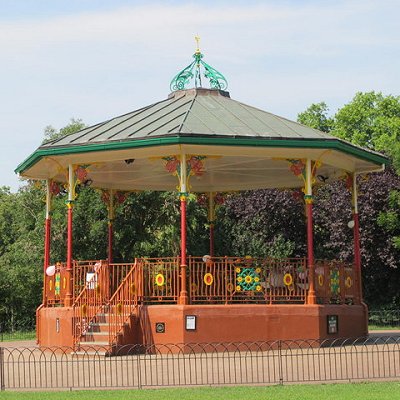
In summer 1979, The Jam recorded their music video When You're Young in Queen's Park, making use of the bandstand.
In 1986, Brent Council with the support of English Heritage made the area around Queen's Park a Conservation Area in recognition of its special architectural and historic character. Subsequently, in 1993 the designated area was extended westwards towards Chamberlayne Road.
The park was laid out by Alexander McKenzie between March 1887 and June 1887. McKenzie was a leading figure in Victorian park design, part of an influential group of landscape designers which included Robert Marnock, Joseph Meston and William Robinson who led garden design away from the parterres and geometry of earlier Victorian gardens to a more natural style of gardening.
Designed without any straight paths, Queen's Park makes extensive use of bold tree planting and shrubberies with natural outlines, and large open areas of lawn for recreation and sport.
Facilities in the park include six all-weather tennis courts, a pitch-and-putt course, an ornamental quiet garden, a children's playground with paddling pool, a children's animal farm and a cafe.
A landmark in the park is the bandstand, which was completed in 1887 using ironwork supplied by Walter Fariane & Co. of Glasgow, and a timber roof with wrought-iron scrolled devices to each facet, and a central wrought- iron lantern. The bandstand was Grade-II listed in 2000.
The park is managed by the City of London Corporation. In 2020 it won Green Flag status for the 24th year in a row, and an additional Green Heritage Site award for its care and conservation of open space and facilities.
The City of London focuses on sustainable management, recycling as much waste as possible. Grass clippings and wood are used to make mulch for shrubberies; everyday waste like cans, bottles and plastics are separated and recycled. Residents bring in their Christmas trees, which are mulched and return for use on their own gardens. Rain water is recycled via a new drainage system. All water runs into a holding tank underground and can be pumped to various areas when needed.
|