|
Dollis Hill is an area in northwest London, which consists of the streets surrounding the 35 hectares (86 acres) Gladstone Park. It is served by a London Underground station, Dollis Hill, on the Jubilee line, providing good links to central London. It is in the London Borough of Brent, close to Willesden Green, Neasden and Cricklewood, and is in the postal districts of NW2 and NW10.
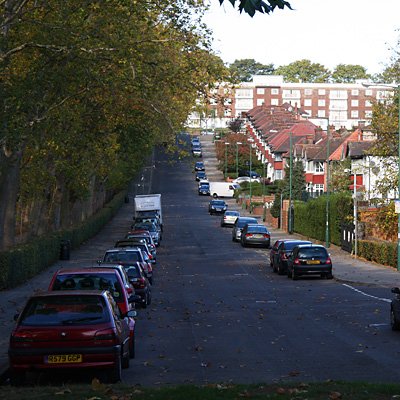
The area is mainly residential (Edwardian terraced and 1920s/30s semi-detached houses) with a restaurant, greengrocer and convenience stores near the underground station. The Dollis Hill ward has the highest Irish population in London.
Dollis Hill played a part in the Second World War as the code-breaking computer used at Bletchley Park was built at the Post Office Research Station in Dollis Hill and the rarely used alternative Cabinet War Room bunker for Winston Churchill's government was dug underground here.
The Dollis Hill Estate was formed in the early 19th century, when the Finch family bought up a number of farms in the area to form a single estate. Dollis Hill House itself was built in the 1820s. It was later occupied by Lord Aberdeen who often had Prime Minister William Ewart Gladstone to stay as a guest.
In 1901, a new public park was created the 35 hectares (86 acres) Gladstone Park, named after the former Prime Minister. An underground station, Dollis Hill Underground station, was opened on 1 October 1909 as part of the Metropolitan line, now on the Jubilee line. Between the park and the underground station, Edwardian terraced houses were built at this time on a grid with names starting with letters in alphabetical order (with some letters missing) from Aberdeen to Normanby.
The first railway in the area was the Dudding Hill Line, opened in 1875 by the Midland Railway to connect its Midland Main Line and Cricklewood goods yard in the east to other lines to the southwest. The Dudden Hill station on the line closed for passengers in 1902, but the line still carried freight.
In World War I, between 1917 and 1921, the tank design team (The Mechanical Warfare Supply Department of the Ministry of Munitions) responsible for the new Anglo-American or Liberty tank, Mark VIII was located here. Early trials of some of the first military tanks were conducted in Dollis Hill. Images of the tanks in Dollis Hill are held at The Imperial War Museum, London.
The Post Office Research Station was built in 1921. The code-breaking Colossus computer, used at Bletchley Park during the Second World War, was built at here by a team led by Tommy Flowers. The station was relocated to Martlesham Heath at the end of the 1970s. The Post Office Research Station building has now been converted into 62 flats and is now known as 'Chartwell Court', with an access road called 'Flowers Close'.
The alternative Cabinet War Room bunker for Winston Churchill's World War II government code-named Paddock is located under a corner of the former Post Office Research Station in Brook Road.
Medium-sized, semi-detached houses were built to the east of this area between 1927 and 1935.
The Grunwick dispute in the late 1970s concerned trade union recognition, working conditions and employment law. It centred on the Grunwick Film Processing Laboratories in Chapter Road, Dollis Hill. The protracted dispute became a cause célèbre in the trade union movement at the time, with several acrimonious interactions between large numbers of police and mass pickets.
|