|
Harefield is a village in the London Borough of Hillingdon, England, 17 miles (27 km) northwest of Charing Cross near Greater London's boundary with Buckinghamshire to the west and Hertfordshire to the north. The population at the 2011 Census was 7,399.
Harefield is near Denham, Ickenham, Northwood, Rickmansworth, Ruislip and Uxbridge. Pioneering heart surgery techniques were developed at Harefield Hospital.
Two sites near Dewes Farm have produced late Mesolithic artefacts. Harefield enters recorded history through the Domesday Book (1086) as Herefelle, comprising the Anglo-Saxon words Here "[danish] army" (cf. the English fyrd) and felle (later feld), "field". Before the Norman conquest of England, the Manor of Harefield belonged to Countess Goda, the sister of Edward the Confessor. Her husbands were French, Dreux of the Vexin and Count Eustace of Boulogne.
Following the Norman conquest, ownership of Harefield passed to Richard FitzGilbert, the son of Count Gilbert of Brionne. It was listed in the Domesday Book as comprising enough arable land for five ploughs, with meadow land only sufficient for one plough. Woodland areas in Middlesex were registered in the number of pigs which could be supported there; Harefield had 1,200, the second highest in the Hundred of Elthorne to Ruislip, with 1,500. Ten villeins (tenants) are also counted; they held their land freely from the lord in exchange for rent payments and labour. By the 12th or 13th century their land is believed to have passed back to the lord and become unfree. There were also seven bordars (poorer tenants) with five acres each, while one had three. In addition, three cottars, who owned a cottage and garden, also feature.
Harefield was eventually split into the main manor of Harefield, and the two smaller submanors of Brackenbury and Moorhall. It had been owned by the Clares, descended from Richard FitzGerald, before passing to the Batchworths by 1235. In turn, the Swanlord family took possession in 1315. By 1446, the Newdigate family owned Harefield - they still owned some land in the 1920s. John Newdigate exchanged most of his land in 1585 with the Chief Justice of the Court of Common Pleas, Sir Edmund Anderson. He sold the manor to Sir Thomas Egerton, who staged an elaborate entertainment for Queen Elizabeth in 1602.
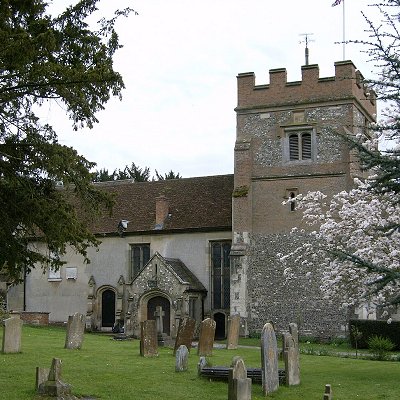
During World War I, Harefield Park was used as an Australian military hospital. The bodies of the servicemen who died there were buried with full military honours within the graveyard of St Mary's Church; the area, which also included the ground where the Harefield Place building stood, became a military cemetery.
In 1929 Harefield became part of the Municipal Borough of Uxbridge, then in 1965 the London Borough of Hillingdon.
|