|
Hampstead, commonly known as Hampstead Village, is an area of London, England, 4 miles (6.4 km) northwest of Charing Cross. Part of the London Borough of Camden, it is known for its intellectual, liberal, artistic, musical and literary associations and for Hampstead Heath, a large, hilly expanse of parkland. It has some of the most expensive housing in the London area. The village of Hampstead has more millionaires within its boundaries than any other area of the United Kingdom.
The name comes from the Anglo-Saxon words ham and stede, which means, and is a cognate of, the Modern English "homestead".
Early records of Hampstead can be found in a grant by King Ethelred the Unready to the monastery of St. Peter's at Westminster (AD 986), and it is referred to in the Domesday Book (1086) as being in the hundred of Ossulstone.
The growth of Hampstead is generally traced back to the 17th century. Trustees of the Well started advertising the medicinal qualities of the chalybeate waters (water impregnated with iron) in 1700. Although Hampstead Wells was initially most successful and fashionable, its popularity declined in the 1800s due to competition with other fashionable London spas. The spa was demolished in 1882, although a water fountain was left behind.
Hampstead started to expand following the opening of the North London Railway in the 1860s (now the London Overground with passenger services operated by Transport for London), and expanded further after the Charing Cross, Euston & Hampstead Railway opened in 1907 (now part of London Underground's Northern line) and provided fast travel to central London.
Much luxurious housing was created during the 1870s and 1880s, in the area that is now the political ward of Frognal & Fitzjohns. Much of this housing remains to this day.
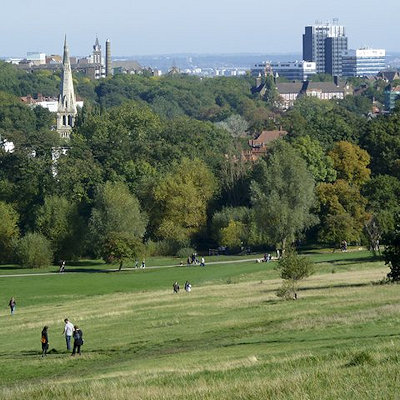
To the north and east of Hampstead, and separating it from Highgate, is London's largest ancient parkland, Hampstead Heath, which includes the well-known and legally-protected view of the London skyline from Parliament Hill. The Heath, a major place for Londoners to walk and "take the air", has three open-air public swimming ponds; one for men, one for women, and one for mixed bathing, which were originally reservoirs for drinking water and the sources of the River Fleet. The bridge pictured is known locally as 'The Red Arches' or 'The Viaduct', built in fruitless anticipation of residential building on the Heath in the 19th century.
Local activities include major open-air concerts on summer Saturday evenings on the slopes below Kenwood House, book and poetry readings, fun fairs on the lower reaches of the Heath, period harpsichord recitals at Fenton House, Hampstead Scientific Society and Hampstead Photographic Society.
The largest employer in Hampstead is the Royal Free Hospital, Pond Street, but many small businesses based in the area have international significance. George Martin's AIR recording studios, in converted church premises in Lyndhurst Road, is a current example, as Jim Henson's Creature Shop was before it relocated to California.
The area has some remarkable architecture, such as the Isokon building in Lawn Road, a Grade I listed experiment in collective housing, once home to Agatha Christie, Henry Moore, Ben Nicholson and Walter Gropius. It was recently restored by Notting Hill Housing Trust.
|