|
Kingsbury is a district of northwest London in the London Borough of Brent. Its ancient scope stretches to include various distinct areas that were once small villages until the inter-war period. In 2001, Kingsbury was a ward, and in 2011 was approximately identifiable with the Fryent and Barnhill wards. Today, Kingsbury forms a quiet suburb between Fryent Country Park to the west and the Brent Reservoir to the east, along with a tube station of the same name and accompanying shopping district on the western side. The postal district is NW9, which it shares with Colindale and West Hendon.
The name Kingsbury means "The King's fortification".
Kingsbury was an ancient parish of a fairly modest 6.9 square kilometres (2.7 sq mi) in the Hundred of Gore and county of Middlesex. Following local government redrawing of electoral wards Kingsbury corresponds to the Fryent and Barnhill wards and in all of its various older guises, a minority or all of the Queensbury ward.
The early English kings had parted with their manor of Kingsbury long before the Conquest. An estate called Tunworth, in the northern part of Kingsbury parish, was granted by Edwy to his thegn Lyfing in 957. By 1066 it probably formed part of the manor of Kingsbury, which was then held by Wlward White, a thegn of the Confessor, and passed from him to Ernulf of Hesdin who died in 1097 and his lands passed to the family of Walter of Salisbury. Thereafter the overlordship of Kingsbury descended with Edgware manor. By 1086 on the Domesday survey of property, Ernulf's manor in Kingsbury had been subinfeudated to Albold as Lord. It was not mentioned again until 1317, when, under the name of the manor of Kingsbury, it belonged to Baldwin Poleyn of Tebworth.
Kingsbury developed little in housing and population in the 19th century, remaining a polyfocal village. In this age, Oliver Goldsmith, writer and playwright, lived at Hyde Farm, Kingsbury (1771-1774); the third Lord Mansfield was buried at St. Andrew's churchyard in 1840.
Although it lay close to London, development started slowly, and it was not until after the First World War that the district became built up. An aircraft industry was established in the part of Kingsbury adjacent to Hendon aerodrome during the war, while the road network was improved to cater for the British Empire Exhibition in nearby Wembley in 1924. The number of inhabited houses in the civil parish increased from just 140 in 1901 to 3,937 in 1931. By 1951 this had risen to 11,776. Between 1921 and 1931 Kingsbury's population increased by 796%.
Population growth meant the existing parish church, built in 1884, dedicated to the Holy Innocents, and adjacent to the more historic Old St Andrew's church, became too small. It was replaced during the 1930s. The current church, completed to designs by Samuel Daukes in 1847, had originally been constructed in Wells Street in central London but after its use declined it was deconstructed, transported and rebuilt (by Holland, Hannen & Cubitts, directed by architect William Adam Forsyth) in its entirety in Kingsbury in 1933–34.
John Logie Baird's experimental television transmissions from the United Kingdom to Berlin, Germany were transmitted from the stable block of Kingsbury Manor; this later housed the Veterans Club, and is now a children's nursery.
From 1923 to 1979 Kingsbury Road was the location of the Vanden Plas specialist motor body works, body makers for Bentley and later part of Austin, BMC, and British Leyland. The site is now Kingsbury Trading Estate.
A congregation of Jews affiliated to the United Synagogue is first recorded in Kingsbury in 1939. In 1942 Eden Lodge at Kingsbury Green was registered for worship, becoming Kingsbury district synagogue in 1954.
A major part of the district is the large Fryent Country Park which contains fields, woods, a fish pond, and a farm, and adjoins Barn Hill to the south.
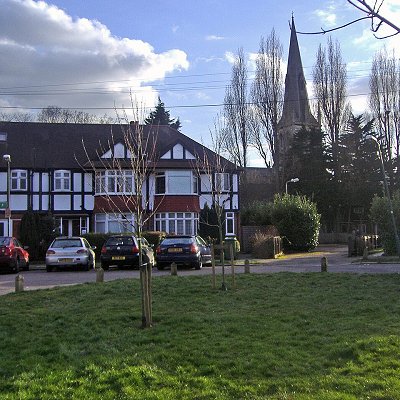
The centre of Kingsbury Green which is today around the Kingsbury Road/Church Lane crossing was historically the centre of Kingsbury in the 15th century, built 1 mile north from the former settlement at Blackbird Hill. To its south, Church Lane leads to the St Andrew's parish church, built in 1933. In Slough Lane and Buck Lane there exist 1920s timbered houses designed by Ernest Trowbridge .
On the east side of the green is the Kingsbury Trading Estate, which formerly housed a United Dairies depot. This area was once an aerodrome run by the Barningham brothers under their company Kingsbury Aviation, until the 1920s. Afterwards the site was taken by Vanden Plas. The Kingsbury Works site continued manufacturing vehicles until it closed in 1979. On the west side of the green lies Kingsbury Synagogue.
Fryent (between Kingsbury Green and Blackbird Hill) meets the Welsh Harp to its east and has a road crossing the reservoir towards West Hendon. This part in the south retains traces of the district's quiet, wooded appearance.
|