|
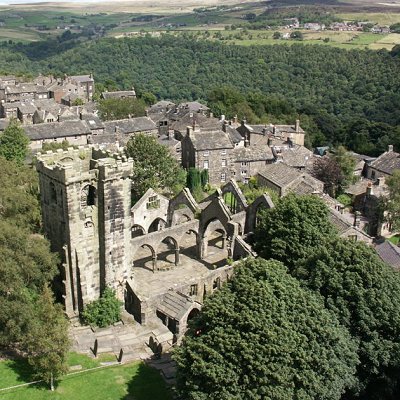
Heptonstall is a small village and civil parish within the Calderdale borough of West Yorkshire, England, historically part of the West Riding of Yorkshire. The population of Heptonstall, including the hamlets of Colden and Slack, is 1,448, increasing to 1,470 at the 2011 Census.[1] The town of Hebden Bridge lies directly to the south-east.[3] Although Heptonstall is part of Hebden Bridge as a post town, it is not within the Hebden Royd town boundaries.
The village is on the route of the Calderdale Way, a 50-mile (80 km) circular walk around the hills and valleys of Calderdale.
The place-name 'Heptonstall' is first recorded as Heptonstall in the 1274 Wakefield Court Rolls, and in 1316 in the Feudal Aids. The name means "the stall or stable in Hebden". The name 'Hebden' means "rose-hip dene or valley".
Heptonstall initially formed part of the manor of Halifax-cum-Heptonstall, itself subinfeudatory to the manor of Wakefield, and so does not explicitly appear in early taxation records, such as those for the 1379 Poll Tax. In 1626 the manor was spun-off and sold and was extinguished in the late 19th century.
Heptonstall was the site of a battle during the early part of the English Civil War in 1643.
Historically a centre for hand-loom weaving, Heptonstall's cottages and terraced houses are characterised by large first-floor windows to maximise the light for weaving.
The older churchyard claims "King" David Hartley amongst notable graves there. Hartley was founder of the Cragg Coiners and lived as a rogue in the Calderdale area until he was hanged at Knavesmire (Tyburn) near York in 1770.
The foundation stone of its octagonal Methodist chapel, the oldest still in continued use, was laid following the visit of John Wesley in 1764.
In the mid-1980s the paving on a road through Heptonstall was removed, revealing the original stone setts. Although there was a plan to remove the setts, local protests convinced the council to restore them. At the same time the existing concrete street lights were replaced with late 19th-century cast-iron gas-style electric lamps. Both developments acted as a traffic calming measure.
|