Like us on Facebook
PLACE NAMES


|
|
Baildon
|
| |
|
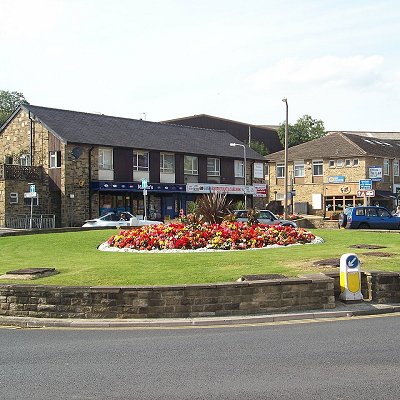
Baildon is a townand civil parish in the Bradford Metropolitan Borough in West Yorkshire, England and within the historic boundaries of the West Riding of Yorkshire.
It lies 3 miles (5 km) north of Bradford city centre. The town forms a continuous urban area with Shipley and Bradford, and is part of the West Yorkshire Built-up Area. Other nearby suburbs include Shipley to the south and Saltaire to the west. As of the 2011 census, the Baildon ward had a population of 15,360.
Cup-and-ring stones on Baildon Moor have shown evidence of Bronze Age inhabitation.
Baildon Moor has a number of gritstone outcrops with numerous prehistoric cup and ring marks. A denuded and mutilated bank represents the remains of an Iron Age settlement known as Soldier's Trench, sometimes mistaken for a Bronze Age stone circle. A Bronze Age cup-marked rock is incorporated in the bank.
The name Baildon derives from the Old English begeldun meaning 'bend hill' or 'circle hill'.
Baildon is recorded as Beldone and Beldune in the Domesday Book. In 1066 it belonged to a Gospatric, son of Arnketil, and had passed to Erneis of Buron by 1086.
Baildon had two manor houses: one on Hall Cliffe, the other in lower Baildon.
During the Industrial Revolution, Baildon developed a woollen industry; Westgate House was built in 1814 by the Ambler family who were prominent in the wool trade and the warehouse part of the building was Feathers Bakery now Nine Café adjacent to the mill which is now the Westgate Bar.
During the 19th and early 20th centuries, conditions in Bradford deteriorated and poverty and ill health became widespread; Baildon began developing as a commuter town along with neighbouring Shipley. In the 1960s, the Hall Cliffe manor house was demolished and replaced with the Ian Clough Hall, named after a local mountaineer. In the latter years of the 20th century, the West Riding suffered from economic decline through the gradual closure of its textile and engineering industries. Bradford was particularly affected by this; however, Leeds grew as a major administrative and financial centre and Baildon with its railway links to Leeds has become a strategic commuter town.
Baildon was an important location for the British Gypsy community. A report of 1929 stated that annual Gypsy Parties had started two to three hundred years before - records were said to go back to 1770 when it was reported to be an ancient custom. In 1881, up to 5,000 people are said to have paid for admission. Gradually the event was taken over by local residents, who dressed up as Gypsies and formed 'tribes'. Proceeds went to the local horticultural society. After 1897 the tradition died out, apparently because the 'real Gypsies' had disappeared. However, in 1929 it was revived to raise funds for Baildon Hospital. A local resident, John Keen, then contacted the so-called King of the Gypsies, Xavier Petulengro, and they re-established large Gypsy gatherings at Baildon, recorded on Pathe News films and shown nationally in cinemas.
The Gypsy Parties ended with the start of the Second World War, and were never revived.
In northern Shipley off Prod Lane there was a small fairground with dodgem cars, booths and a historic "Aerial Glide" suspended roller coaster that for a short period had listed building status. In earlier years the fairground attractions at Shipley Glen were much more extensive. The fairground closed and is now dismantled and newly built (2015/6) private housing now covers the site. The only working remnant of the Pleasure Grounds is the Shipley Glen Cable Tramway, a funicular railway carrying passengers from just north of Roberts Park, Saltaire up the hill side through Walker Wood to the location of the Pleasure Grounds at the top of Prod Lane.
|
 Feel free to Email me any additions or corrections
LINKS AVAILABLE TO YOUR SITE
| |


