|
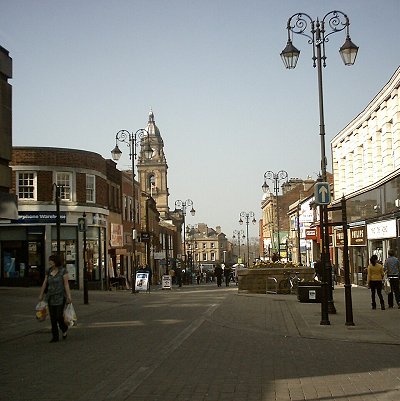
Morley is a market town and a civil parish within the City of Leeds metropolitan borough, in West Yorkshire, England. Morley is the largest town in the borough after Leeds itself. Morley forms part of the Heavy Woollen District.
It lies approximately 5 miles (8 km) south-west of Leeds city centre. It was built on seven hills: Scatcherd Hill, Dawson Hill, Daisy Hill, Chapel Hill, Hunger Hill, Troy Hill and Banks Hill. In 2011, the town and civil parish had populations of 44,440 and 27,738 respectively.It includes the New Brighton area.
The town is split between the Morley North and Morley South wards (containing the town centre) of Leeds City Council, both making up part of the Leeds South West and Morley parliamentary constituency.
Morley was mentioned in the Domesday Book in 1086 as Morelege, Morelei and Moreleia. Morley means "open ground by a moor", from Old English mor "moor, clearing, pasture" + leah "open ground, clearing". It gave its name to Morelei Wapentac, a wapentake which probably met at Tingley.
Howley Hall was built during the 1580s by Sir John Savile, a member of the great Yorkshire landowners, the Savile family. The house was besieged during the English Civil War in 1643 before the Battle of Adwalton Moor but appears to have sustained no serious damage. It continued to be occupied during the 17th century but fell into disrepair. The hall was demolished in 1730 but ruins exist including the cellars of its great hall.
The town became famous for its textile industry, notably the cloth, shoddy, which was worn by both sides in the American Civil War.
It was a significant coal mining area. On 7 October 1872, 34 people were killed in an explosion at the Morley Main Colliery.
|