Like us on Facebook
PLACE NAMES


|
|
Marsden
|
| |
|
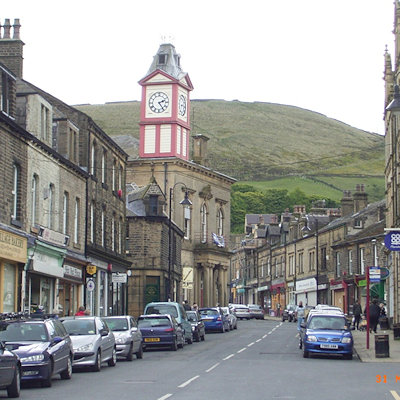
Marsden is the last significant settlement on the West Yorkshire side of Standedge crossing of the Pennines into Greater Manchester. The village is surrounded on three sides by the high moors which are called Marsden Moor and Meltham Moor although Saddleworth Moor is very close. Saddleworth Moor is known for the place of burial for the moors murders. Marsden has low level access only from the east along the Colne Valley.
Several generations of tracks and roads have crossed the moors at this point. There are two distinctive packhorse bridges in the town (Mellor Bridge by the church, and Close Gate Bridge at the edge of the moor to the east of the village), whilst the current A62 main road crosses through the Standedge cutting some 2.5 miles (4 km) to the west. Both the Huddersfield Narrow Canal and the Huddersfield to Manchester railway also pass through Marsden, entering the parallel rail and canal Standedge Tunnels about half a mile (0.8 km) to the west of the town. Marsden railway station is located in the village on the railway line.
Marsden Moor Estate, which surrounds Marsden to the west and south, and includes several reservoirs, is in the care of the National Trust. The Trust is developing new techniques to rehabilitate the moor.
Butterley Reservoir with its distinctive spillway is one of the reservoirs near Marsden. In chronostratigraphy, the British sub-stage of the Carboniferous period, the Marsdenian derives its name from Marsden.
Marsden grew wealthy in the nineteenth century from the production of woollen cloth. It is still home to Bank Bottom Mill, later known as Marsden Mill, and home to John Edward Crowther Ltd, formerly one of the largest mills in Yorkshire. The Crowthers moved to Marsden in 1876, beginning a long and profitable association with cloth manufacturing in the town.
During the 1930s Bank Bottom Mill covered an area of 14 acres, employed 680 looms, and provided employment for 1,900 workers.
The present Church of St Bartholomew was completed in 1899, although the nave and aisle had been in use from 1895, when the previous chapel was demolished. The tower was built in 1911, and the Parochial Hall in 1924 (with an extension in 1978). The church has a peal of ten bells.
Production of woollen cloth at Bank Bottom Mill ceased in 2003, with the loss of 244 jobs.
|
 Feel free to Email me any additions or corrections
LINKS AVAILABLE TO YOUR SITE
| |


