Like us on Facebook
PLACE NAMES


|
|
Bingley
|
| |
|
Bingley is a market town and civil parish in the metropolitan borough of the City of Bradford, West Yorkshire, England. It is sited on the River Aire and the Leeds and Liverpool Canal. The town had a population of 18,040 at the 2021 Census.
In 1775, a farmer near Bingley discovered a chest of silver coins, of which some dated to the rule of Julius Caesar, on his land.
Bingley was likely founded by the Saxons, by a ford on the River Aire. This crossing gave access to Harden, Cullingworth and Wilsden on the southern side of the river.
The origins of the name are from the Old English personal name Bynna + ingas ("descendants of") + leah ("clearing in a forest"). Altogether, this would mean the "wood or clearing of the Bynningas, the people called after Bynna".
In the Domesday Book of 1086, Bingley is listed as "Bingheleia":
The ford was superseded by Ireland Bridge. Bingley was a manor which extended several miles up and down the Aire valley, extending upstream to Marley on the outskirts of Keighley and downstream to Cottingley. Bingley became a market town with the grant of a Market Charter in 1212 by King John.
According to the poll tax returns of 1379, Bingley had 130 households, and probably around 500 people. The nearby towns of Bradford, Leeds and Halifax had about half this population. Therefore, at this time Bingley was the largest town in the area.
No records tell of how Bingley fared in the Black Death that swept Europe in the 14th century. Approximately one third of all the people in Europe died of this plague, sometimes wiping out whole towns and villages. According to the 1379 Poll tax records, the nearby town of Boulton had no survivors worth taxing.
In 1592, Bingley was shown on a map by Yorkshire map-maker Christopher Saxton as a single street with about 20 houses on each side. The church sits at the west end of the street opposite a single large house, possibly a manor house. Since Bingley was a market town, the market stalls would have been set up on either side of the main street. One of the oldest buildings in Bingley is a coaching inn, the Old White Horse Inn, on the flatter north bank of the River Aire by Ireland Bridge.
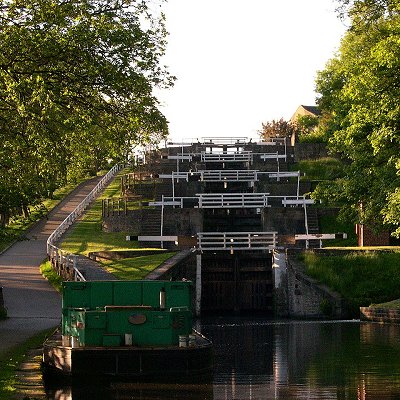
Like many towns in the West Riding, Bingley prospered during the Industrial Revolution. The Bingley section of the Leeds and Liverpool Canal was completed in 1774, linking the town with Skipton, and Bradford via the Bradford Canal. The canal passes through the town centre and ascends the side of the valley via the Bingley Five Rise and Bingley Three Rise Locks. Several woollen and worsted mills were built and people migrated from the surrounding countryside to work in them. Many came from further afield such as Ireland in the wake of the Great Famine. A railway and line goods yard were constructed bringing further trade. The villages of Gilstead and Eldwick became conurbated with Bingley. The Bingley Building Society was also founded in this period.
Bingley Teacher Training College opened in 1911 with Helen Wodehouse as principal. The first intake of students was 102 women from in and around the then West Riding of Yorkshire. Before its closure in 1979, the college produced approximately 16,000 teachers.
The Beeching Axe demolished the goods yard, although the station still has trains to Leeds, Bradford, Skipton, Morecambe and Carlisle. The textile mills have largely been closed. The Damart mill still stands and trades in textiles. Since 1995 the tannery, Bingley Mill & Andertons, have been converted into flats. The most cramped and outdated terraced housing was partly replaced with council housing, Bingley Arts Centre and the headquarters of the Bradford & Bingley Building Society. Further council housing was built up the hill towards Gilstead including three tower blocks, which were later demolished in 2020. In the wake of Margaret Thatcher's reforms of council housing much of the council estate was sold and a substantial portion has been knocked down and rebuilt as private housing. The Bingley Permanent Building Society merged with the Bradford Equitable Building Society to form the Bradford & Bingley Building Society in 1964. It was decided to site the corporate headquarters in Bingley. This brought several thousand jobs to the town, but the building itself did not meet with universal acclaim and was demolished in 2015. The Bradford and Bingley collapsed in the 2008 credit crunch.
Bingley's most infamous son is Peter Sutcliffe, the Yorkshire Ripper, who was convicted of the murders of 13 women and the attempted murder of seven others. Mark Rowntree, a spree killer, started his murderous campaign in Bingley before moving on to Eastburn and Leeds. He was convicted in 1976 of four murders.
In 1966, bookie Fred Craven was brutally murdered in his betting shop on Wellington Street, Bingley. Craven, who was well known in the area because of his short stature (he was 4 ft 7in tall), had gone into his shop to collect papers despite there being no racing that day. It is believed that he had £200 in his wallet (£3,200.00 in 2015 prices) which went missing. Mr Craven suffered extensive injuries at the hands of the killer. Because the local constabulary had a very narrow time frame for the murder, and the fact the killer must have been covered in blood, they anticipated a quick arrest. The Craven murder remains unsolved, but rumours that Peter Sutcliffe, the Yorkshire Ripper, was responsible for his murder resurfaced in 2017. ITV Calendar News asked Sutcliffe about Craven's death and also that of a taxi driver on Bingley Moor. In what was described as a "bizarre letter", Sutcliffe responded that he was not responsible for either crime to presenter Christine Talbot.
The main road through Bingley has been re-sited twice in its history. In 1904, a new cut of the road heading north west out of the town created a mini-bypass between All Saints Parish Church and the Railway. The cobbled road around the front of the church became Old Main Street. A huge section of the graveyard was taken out to lay the new road and the gravestones were used as flags on the paths around the church. A small section of the graveyard still exists on the east side of the new road bounded by the old path to Treacle Cock Alley and the railway.
Plans had been on the table for a trunk road through Bingley and the Aire valley since at least 1970. In 1992 preparatory work was undertaken to lengthen Park Road bridge so that the Leeds Liverpool Canal could be moved slightly to the east. This work would allow the formation of the new road to be sandwiched between the railway and the canal. In 1998, the Government, gave the go ahead for the trunk road to be constructed.
In 2004, the Bingley Relief Road opened. The £47.9 million road stretches from Crossflatts to Cottingley, threading through Bingley between the railway and the canal. One of the most expensive parts of the construction was moving a 160-yard (150 m) stretch of the canal. The construction involved the removal of Treacle Cock Alley pedestrian tunnel and the Tin Bridge, which have been replaced by the Three Rise Bridge, and the Britannia Bridge
In 2004, the average home price in Bingley rose 30% to £196,850 - the second fastest appreciating area in the UK (after the nearby Hebden Bridge.
The road was a target of road protest camp where protesters occupied tree houses for nearly two years.
|
 Feel free to Email me any additions or corrections
LINKS AVAILABLE TO YOUR SITE
| |


