
Like us on Facebook
PLACE NAMES


|
|
Wallington
|
|
|
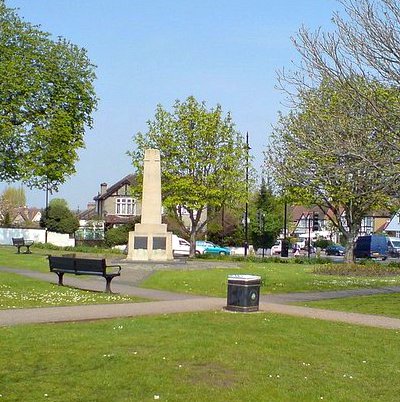
Wallington is a town in the London Borough of Sutton, South London, England, 9.9 miles (16 km) south south-west of Charing Cross. Before the Municipal Borough of Beddington and Wallington merged into the London Borough of Sutton in Greater London in 1965, it was part of the county of Surrey. Wallington is a post town in the SM postcode area.
The name "Wallington" derives from the Anglo Saxon "Waletone", meaning "village of the Britons". Wallington appears in Domesday Book of 1086 and was held by William the Conqueror. Its domesday assets were: 11 hides. It had 2 mills worth £1 10s 0d, 11 ploughs, 8 acres (32,000 m2) of meadow. It rendered £10. The historic village was situated somewhat to the north of the current town centre around what is now Wallington Bridge over the River Wandle.
At the time of the Domesday book there were two mill ponds. The mill buildings have long been demolished, but the mill pond survives as The Grange boating lake. In the 1860s one Alfred Smee, surgeon to the Bank of England, constructed an elaborate garden on the north side of the Mill Pond, and wrote an illustrated book called "My Garden" in 1872.
What was then called "Carshalton" railway station was opened in 1847 in the open fields to the south of Wallington because the owner of Carshalton Park objected to it being built near to Carshalton village. This acted as a spur to the development of the area and in the 1860s Nathaniel Bridges created a prestigious housing estate of gothic revival villas (architect E. L. Brock). To provide a church for the estate, Bridges sponsored the construction of Holy Trinity, and Wallington became a separate parish in 1867. The area around Holy Trinity Church is known as Wallington Old Town. In particular Clifton Road, Belmont Road and Park Road exhibit some imposing Victorian and Edwardian villas. This southward development continued towards Woodcote and by the time of the First World War the section of Woodcote Road to the south of the station had become the new High Street.
Wallington High School for Girls was established in 1888 by a collective of nuns.
Since 1902 the town has maintained the tradition of an annual crowning of the Wallington May Queen. The event begins with a procession through the town. Girls join the group at the age of three as "fairies", before graduating to "attendants to the May Queen" a year later. They then go on to become crown bearers before taking on the role of banner bearer. The girls then act as "princes", and become eligible to be a May Queen at the age of nine.
The Municipal Borough of Beddington and Wallington was incorporated in 1936 from the former Beddington and Wallington Urban District. Wallington Town Hall (architect Robert Atkinson) and public library were built in Wallington town centre in the 1930s, as was the fire station in Belmont Road.
Wallington County Grammar School (for boys) was opened on London Road, close to Beddington Park in 1927.
Wallington was an important centre for the production of lavender oil until about the time of the First World War. Lavender and herb growing were very prominent in the area in Victorian times and much earlier, and extensive fields of lavender were to be seen in the Carshalton, Beddington and Wallington areas. Lavender growing was a very prosperous part of the local agriculture hereabouts in the 19th and early 20th centuries. In Wallington the area to the north of the station was chiefly used. The scale of the operation can be understood from the fact that the Daily News in 1914 was able to state that at nearby Carshalton Beeches "In every direction the low hill sides of the farm beyond Beeches Halt are swept with the bloomy pastel tint of the lavender flowers". The importance of lavender is remembered and commemorated in a number of ways, for example:
There is a large sculpture at the junction of Woodcote Road and Stafford Road representing a lavender plant. Created by sculptor, Guy Portelli, it was installed in 1999 when the new Sainsbury's store was built.
|
 Feel free to Email me any additions or corrections Feel free to Email me any additions or corrections
LINKS AVAILABLE TO YOUR SITE
| |


