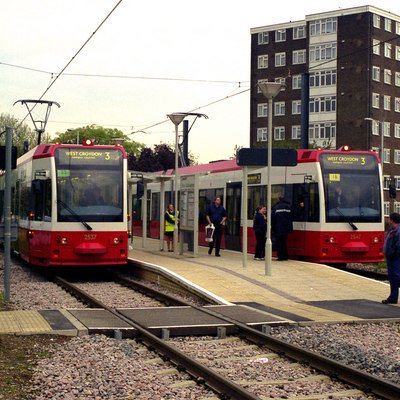
New Addington is an area of South London, England, within the London Borough of Croydon. It is located 5 miles (8 km) south east of Croydon and is adjacent to the Greater London boundary with Surrey.
Until the 1930s, the area now known as New Addington was farmland and woodland in the southeast of the ancient parish of Addington. The farms were called Castle Hill, Addington Lodge (later Fisher's Farm). At the time, central Croydon and London more generally had overcrowded slums causing concern to the authorities. In 1935, the First National Housing Trust purchased 569 acres of Fisher's Farm with the intention of erecting a 'Garden Village', with 4,400 houses, shops, two churches, cinema, and village green. The Chairman of the Trust was Charles Boot, hence the earliest part of New Addington is sometimes called The Boot's Estate.
By 1939, when the outbreak of World War II suspended construction, 1,023 houses and 23 shops had been built. The new estate was popular, but the provision of amenities had not kept pace with the house building. Only one of the proposed schools and few of the shops were in operation. For employment, decent shopping and entertainment, the residents had to travel off the estate. This heralded a long history of isolation for the estate, then nicknamed Little Siberia, because it is much colder than the rest of Croydon. The isolation was partly remedied 60 years later with the arrival of Tramlink route 3, mentioned below. Tramlink runs alongside Lodge Lane, the main (northern) road access. There is only one other point of access by road, where King Henry's Drive connects with minor roads to the south.
After the war, there were concerns about the amount of green space being used for building around London and much of the countryside around the developing estate was designated as Green Belt land. The County Borough of Croydon bought the unused First National Housing Trust land and a further 400 acres to add to it, for extensive further development. Many dozens of single-storey, detached, prefabricated houses (commonly known as "prefabs" of the "Arcon" type using corrugated cement asbestos panels fixed to a bolted steel frame as photographed in "A 1950s metal UK prefab at the Rural Life Centre, Tilford, Surrey.") were built in the Castle Hill area of the estate. These were inhabited until the 1960s when they were demolished and replaced with brick-built two-storey homes.[citation needed] At the same time as the smaller prefabs were built, larger two-storey semi-detached houses were also built. These houses, which had metal upper skins, still survive around the King Henry's Drive area near Tudor Academy (formerly Wolsey School). This was more development than had originally been envisaged but it brought about the structure of the estate as seen today.
|