
Like us on Facebook
PLACE NAMES


|
|
Kenley
|
|
|
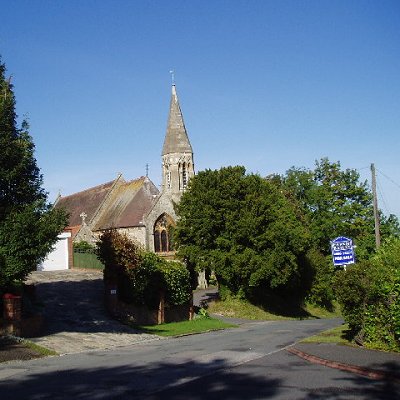
Kenley is a suburb within the London Borough of Croydon. It is located 13 miles (21 km) south of Charing Cross and within the southern boundary of London, England. Surrounded by the Metropolitan Green Belt on three sides, it includes the large open spaces of Kenley Common and Kenley Aerodrome. Kenley was part of the ancient parish of Coulsdon in the county of Surrey and was connected to central London by rail in 1856. As the population of the area was growing, it became part of Coulsdon and Purley Urban District in 1915 and has formed part of Greater London since 1965. At the 2011 Census, Kenley had a population of 14,966.
Kenley was a hamlet in the ancient parish Coulsdon in the county of Surrey. In 1894 the Coulsdon parish became part of Croydon Rural District. Responding to the increase in population in the area, the rural district was broken up in 1915 and the parish of Coulsdon became part of Coulsdon and Purley Urban District. Coulsdon and Purley was incorporated into Greater London in 1965 and became part of the London Borough of Croydon.
Kenley Common comprises 138 acres of green open space surrounding the former Battle of Britain airfield. It is a mixture of chalk grassland and ancient woodland set among gently rolling hills and blessed with fine views across the Caterham valley and the North Downs beyond. The original common was bought by the Corporation of London in 1883. At that time, it encompassed some of the area that is now Kenley Airfield. Over the years, compulsory purchases by the Government and subsequent land acquisitions and re-acquisitions have meant that the Common has changed its shape and position, and almost doubled in size.
The common's history as an airfield goes back to the First World War when planes were assembled and tested for squadrons in France. It proved an important link in the chain of supply and became established as a permanent Royal Air Force station. The Second World War saw concrete runways being laid and, as headquarters of 'B' Sector in the No 11 Group of fighter stations, it was soon playing a key role in the Battle of Britain. Kenley is now the last remaining Battle of Britain fighter station in the southeast to remain in its Second World War form. Evidence of its wartime role has survived and the old blast bays, air raid shelters, officer's mess and the original runways can still be seen. English Heritage identified Kenley as the "most complete fighter airfield associated with the Battle of Britain to have survived".
|
 Feel free to Email me any additions or corrections Feel free to Email me any additions or corrections
LINKS AVAILABLE TO YOUR SITE
| |


