|
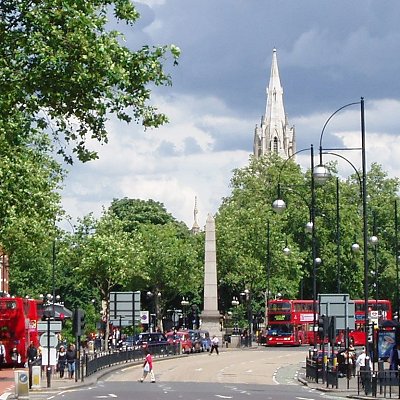
Stratford is a town and district of West Ham, East London, England, in the London Borough of Newham. Part of the Lower Lea Valley, it is six miles (ten kilometres) northeast of Charing Cross, and includes Maryland and East Village.
Historically an ancient parish in the hundred of Becontree in Essex, following reform of local government in London in 1965 it became part of the borough of Newham in the newly formed Greater London.
Stratford grew rapidly in the 19th century after the railway came to the area in 1839, forming part of the conurbation of London, similar to much of south-west Essex. The late 20th century was a period of severe economic decline in the area, eventually reversed by ongoing regeneration associated with the 2012 Summer Olympics, for which Stratford's Queen Elizabeth Olympic Park, part of the large, multi-purpose Stratford City development, was the principal venue. The Westfield Stratford City shopping centre, one of the largest urban shopping centres in Europe, opened in 2011. Stratford is east London's primary retail, cultural and leisure centre, and has also become the second most significant business location in east London after Canary Wharf.
Stratford's early significance was due to a Roman road (later known as the Great Essex Road) running from Aldgate in the City, across the River Lea, to Romford, Chelmsford and Colchester. At that time the various branches of the river were tidal and without channels, while the marshes surrounding them had yet to be drained. The Lea Valley formed a natural boundary between Essex on the eastern bank and Middlesex on the west, and was a formidable obstacle to overland trade and travel.
The name is first recorded in 1067 as Strætforda and means 'ford on a Roman road'. It is formed from Old English 'stræt' (in modern English 'street') and 'ford'. The former river crossing lay at an uncertain location north of Stratford High Street.
The district of Old Ford in northern Bow – west of the Lea – is named after the former crossing, while Bow itself was also initially named Stratford, after the same ford, and a variety of suffixes were used to distinguish the two distinct settlements, including Stratford-le-Bow.
The settlement to the east of the Lea was also known as Estratford (recorded in 1291), referring to the location east of the other Stratford, Statford Hamme (recorded in 1312) alluding to the location within the parish of West Ham, Abbei Stratford, referring to the presence of Stratford Langthorne Abbey, and Stretford Langthorne (recorded in 1366) after a distinctive thorn tree (possibly a pollarded Hawthorn) which stood in the area. The thorn tree itself, was mentioned much earlier, in a charter of the Manor of Ham, in 958 AD. The tree is thought to have stood in the vicinity of the modern Channel Sea rail junction, around 200 metres north-north-west of the London Aquatics Centre.
|