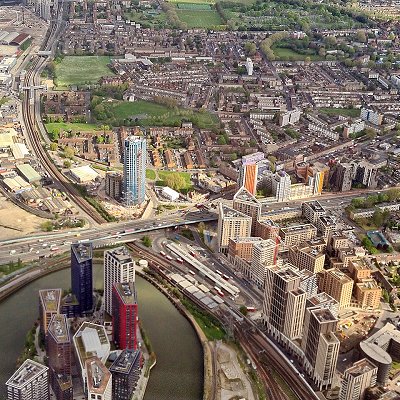
Canning Town is a district of West Ham in the London Borough of Newham, East London, England, north of the Royal Victoria Dock. Its urbanisation was largely due to the creation of the dock. The area was part of the ancient parish and County Borough of West Ham. It forms part of the London E16 postcode district.
The area is undergoing significant regeneration as of 2012, with the building of up to 10,000 new homes.
Before the 19th century, the district was largely marshland, and accessible only by boat, or a toll bridge. In 1809, an Act of Parliament was passed for the construction of the Barking Road between the East India Docks and Barking. A five-span iron bridge was constructed in 1810 to carry the road across the River Lea at Bow Creek. This bridge was damaged by a collision with a collier in March 1887 and replaced by the London County Council (LCC) in 1896. This bridge was in turn replaced in 1934, at a site to the north and today's concrete flyover begun in smaller form in the 1960s, but successively modified to incorporate new road layouts for the upgraded A13 road and a feeder to the Limehouse Link tunnel, avoiding the Blackwall Tunnel. The abutments of the old iron bridge have now been utilised for the Jubilee footbridge, linking the area to Leamouth, in the London Borough of Tower Hamlets, on the western bank of the Lea.
The area is thought to be named after the first Viceroy of India, Charles John Canning, who suppressed the Indian Rebellion of 1857 about the time the district expanded. The population increased rapidly after the North London Line was built from Stratford to North Woolwich, in 1846. This was built to carry coal and goods from the docks; and when the passenger station was first built it was known as Barking Road. Speculative builders constructed houses for the workers attracted by the new chemical industries established in the lower reaches of the River Lea, and for the nearby Thames Ironworks and Shipbuilding Company and Tate & Lyle refinery.
The opening of the Royal Victoria Dock in 1855 accelerated the development of the area creating employment and a need to house dock workers and their families. New settlements around the dock developed, starting with Canning Town and Hallsville (Hallsville generally being seen as part of Canning Town), and later the areas now known as Custom House and Silvertown. The new settlements lacked water supply and had no sewage system, leading to the spread of cholera and smallpox. The casual nature of employment at the docks meant poverty and squalid living conditions for many residents, and in 1857 Henry Morley wrote about the area: "Canning Town is the child of the Victoria Docks. The condition of this place and of its neighbour prevents the steadier class of mechanics from residing in it. They go from their work to Stratford or to Plaistow. Many select such a dwelling place because they are already debased below the point of enmity to filth; poorer labourers live there, because they cannot afford to go farther, and there become debased. The Dock Company is surely, to a very great extent, answerable for the condition of the town they are creating. Not a few of the houses in it are built by poor and ignorant men who have saved a few hundred pounds, and are deluded by the prospect of a fatally cheap building investment."
The industries around the dock were often unhealthy and dangerous. As trade unions and political activists fought for better living conditions and the dock area became the centre of numerous movements with Will Thorne, James Keir Hardie and other later becoming leading figures in the Labour Party. Thorne and others worked and gave speeches at Canning Town Public Hall which had been built in 1894 as the population grew in the southern part of the borough.
From the late 19th century, a large African mariner community was established in Canning Town as a result of new shipping links to the Caribbean and West Africa. Prior to the Windrush era, Canning Town had London's largest black population of any area in London. The area around Crown Street (formerly located just north of the Royal Victoria Dock, but destroyed in the Blitz) was known as Draughtboard Alley due its ethnic mix.
In 1917 50 tons of TNT exploded at the Brunner Mond & Co ammunition work in nearby Silvertown, causing the Silvertown explosion, the largest explosion in London's history and damaging more than 70,000 buildings and killing 73 people.
In the 1930s the County Borough of West Ham commenced slum clearances. New houses, clinics, nurseries and a lido were opened. Silvertown ByPass and Britain's first flyover, the Silvertown Way, were built along with other new approach roads to the docks. Canning Town was heavily hit by the bombings in World War II and West Ham Council's plan to rebuild the area focused on a reduction of the population, transferring industry and the building of new housing such as the Keir Hardie Estate, which included schools and welfare services.[6] In the early hours of 10 September 1940, a bomb hit South Hallsville School where up to 600 local refugees were accommodated. At least 200, mainly children, were killed or injured. Many bodies were never recovered.
The slum clearances and the devastation of World War II, destroying 85% of the housing stock, led to the preponderance of council estates that characterise the area today. Post-war housing schemes followed the urban planning principles of the garden city movement. As demand for housing grew the first high rise buildings were built in Canning Town in 1961. In 1968 part of Ronan Point, a 22-storey tower block, collapsed and most of the tall tower blocks built in the area in the early 1960s were eventually demolished or reduced in size.
|