
Like us on Facebook
PLACE NAMES


|
|
Raynes Park
|
|
|
 | Old Town Hall, Whittaker Avenue, Richmond - 020 8940 9125
St. Paul's Churchyard, London - 020 7332 3456
visit@cityoflondon.gov.uk
|
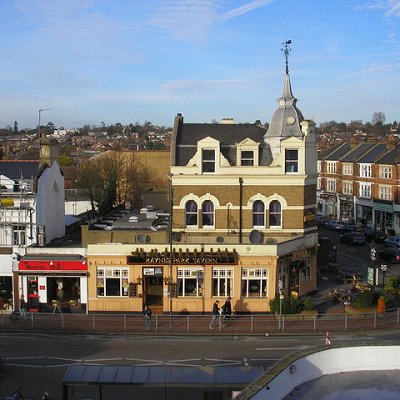
Raynes Park is a residential suburb, railway station and local centre near Wimbledon, London, and is within the London Borough of Merton. It is situated southwest of Wimbledon Common, to the northwest of Wimbledon Chase and to the east of New Malden, in South West London. It is 7.8 miles (12.5 km) southwest of Charing Cross. Towards the north and west, either side of the borough boundary with the Royal Borough of Kingston upon Thames are the areas of Copse Hill and Coombe with their large detached houses, golf courses and gated lands. Raynes Park had a population of 19,619 in 2011, which refers to the populations of the wards of Raynes Park and West Barnes. The district of Raynes Park is composed of the neighbourhoods Motspur Park (West Barnes), Raynes Park itself, Shannon Corner and Grand Drive.
Raynes Park is part of the Wimbledon constituency for elections to the House of Commons of the United Kingdom.
Raynes Park is 7.8 miles from Central London and has one of the largest proportions of green open space in South London. The area has a number of parks including Cottenham Park Recreation Ground, named after Charles Pepys, 1st Earl of Cottenham, and Cannon Hill Common. It lies approximately 2.5 miles (4 km) north of the Greater London border with Surrey.
Cannon Hill Common covers 21 hectares of open space, and is a site of borough importance - Grade 1 for Nature Conservation. It contains mature woodland that is over 140 years old and provides a habitat for a variety of fauna and flora.
Historically, the area of Raynes Park south of Coombe Lane and Kingston Road was part of the parish of Merton and the area north of that line was part of the Parish of Wimbledon. The area remained rural until late into the 19th century. The first development in the area was the opening of the London & South Western Railway in May 1838 which crossed the area on a high embankment, although the station did not open until 1871.
Cottenham Park to the north of the station was the first part of the area to be laid out for development in the 1870s. It takes its name from Charles Pepys, 1st Earl of Cottenham who lived in Wimbledon until his death in 1851. The name Raynes Park was originally used in the 1870s and only applied to the area south of the railway line where the local landowner, Richard Garth, Lord of the Manor of the adjacent parish of Morden, planned to develop a new garden suburb similar to that being developed by John Innes at Merton Park to the east. The name refers to the Rayne family, the previous landowners of the farmland on which Garth intended to build.
Garth laid out the northern section of Grand Drive, about as far south as Heath Drive, and Blenheim Road and persuaded the railway company to build the station. A number of detached houses were constructed, but Garth's absence as Chief Justice of Bengal slowed the development and much of the rest of the area became a golf course and cricket grounds.
By the late Victorian period the residential development of Wimbledon was encroaching on the north side of the railway from the east but, apart from a few buildings including the Junction Tavern and a school, development around the station did not start until the beginning of the 20th century.
South of the railway, the twelve terraced roads known locally as "the Apostles" (although they are not named after the Apostles) were laid out over a former cricket ground starting during the Victorian period. In the 1920s, the Kingston Bypass (A3) and its spur, Bushey Road (A298), were built as dual carriageways. South of the railway, the majority of residential development occurred in the 1930s with Grand Drive being extended south into Lower Morden and new roads being developed. During the interwar period, developer George Blay was key in transforming Raynes Park into the place it is today, with his properties still known locally as "Blay houses". Much of the area remains open space.
During World War II the area suffered considerable bombing, especially in 1944 from the V-1 flying bomb.
In 2015, Raynes Park High Street was a finalist in the Great British High Street competition's London category. The competition title was eventually won by Ealing's Pitshanger Lane.
|
 Feel free to Email me any additions or corrections Feel free to Email me any additions or corrections
LINKS AVAILABLE TO YOUR SITE
| |
