
Like us on Facebook
PLACE NAMES


|
|
Mortlake
|
|
|
|
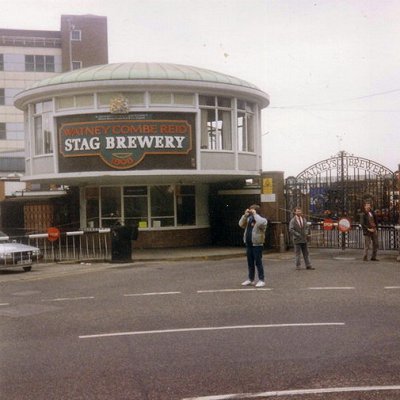
Mortlake is a suburban district of the London Borough of Richmond upon Thames on the south bank of the River Thames between Kew and Barnes. Historically it was part of Surrey and until 1965 was in the Municipal Borough of Barnes. Its Stuart and Georgian history was economically one of malting, brewing, farming, watermen and the Mortlake Tapestry Works (1617-1704), Britain's most important producer. A London landmark, the former Mortlake Brewery or Stag Brewery, is on the edge of Mortlake.
The Waterloo to Reading railway line runs through Mortlake, which has a pedestrianised riverside, two riverside pubs and a village green. The Boat Race finishes at Mortlake every March/April.
The place-name 'Mortlake' is first attested in the Domesday Book of 1086, where it appears as Mortelaga and Mortelage, a name with two possible derivations. If the second element is the Old English lacu meaning a stream, then the first element is very likely the fish-name mort meaning a young salmon, hence 'salmon stream'. If the second element is the dialect lag meaning a long, narrow marshy meadow, then the name means 'Morta's meadow'.
According to the Domesday Book, the manor and parish of Mortlage was held by Archbishop Lanfranc of Canterbury when its assets were: 25 hides; 1 church, 2 mills worth £5, 1 fishery, 33 ploughs, 20 acres (8 hectares) of meadow, wood worth 55 hogs. It rendered a large £38 plus 4s 4d from 17 houses in London, 2s 3d from houses in Southwark and £1 from tolls at Putney per year to its feudal system overlords. The manor belonged to the Archbishops of Canterbury until the time of Henry VIII, when it passed by exchange to the Crown. From the early part of the 17th century until after the English Civil War, Mortlake was celebrated for the manufacture of tapestry, founded during the reign of James I at the Mortlake Tapestry Works.
Mortlake was reduced by 732 acres (296 hectares) when Richmond Park was created by Charles I in 1637. Other parishes also lost smaller amounts of land to the new deer park.
Colston House's forebear was built by Thomas Cromwell, Earl of Essex then acquired by Edward Colston, major benefactor and investor to the port city of Bristol. This was pulled down in 1860. John Barber, Lord Mayor in 1733, a suspected Jacobite opposed to the 'Georgian' House of Hanover but Member of Parliament for the City on the strength of his opposition to Walpole's protectionist excise scheme, was buried in Mortlake in 1741. He had given land to extend the churchyard. Sir Henry Taylor, KCMG, the dramatic poet, lived in Mortlake in the 19th century.
Sir John Barnard, Lord Mayor of London in the year 1737 and also an MP, used public addresses and private campaigns to outstanding effect in supporting the government against the Jacobite movement in 1745.
Since 1845, the Oxford and Cambridge Boat Race has had its finish point at Mortlake, marked by the University Boat Race stone just downstream of Chiswick Bridge. Several other important rowing races over the Championship Course also either start or finish at the stone. The first National School in Mortlake was built providing compulsory education at primary level in 1869, followed by an infants school in 1890 and county level, into secondary level school in 1906. James Chuter Ede taught there in the years leading up to his election to Surrey County Council in 1914, when he became the leading figure in the development of education in Surrey; he eventually became Home Secretary throughout the Attlee administration.
In the 1840s Charles James Philips and James Wigan acquired Mortlake Brewery, which had existed since the 15th century.
In 1889 the brewery was acquired by James Watney & Co., which in 1898 became Watney Combe & Reid after acquiring Messrs. Combe Delafield and Co. and Messrs. Reid and Co. When Watney's Stag Brewery in Victoria, London, was demolished in 1959, the name was 30 years later, applied to Mortlake Brewery. Being the last phase of The Boat Race which refers to all the traditional local names, it is still widely referred to as the Mortlake Brewery.
The brewery became part of Scottish Courage, briefly part of Heineken and was then divested to Anheuser-Busch Europe Ltd as it produced the company's Budweiser pale lager. In January 2009, Anheuser-Busch InBev said that the company was proposing to close the Stag Brewery in 2010 as a result of a merger between InBev and Anheuser-Busch. In November 2015, it was announced that the site had been sold for £158m to Reselton - part of Singapore's City Developments, which also bought the former Teddington Studios. The brewery closed in December 2015 and there are plans to build 850 apartments on the 22-acre (9-hectare) location.
Mortlake affords an undistracted view of the river as its riverside promenade is set by its buildings including the former brewery, unlike the embankment style roads along other London banks such as in Barnes until Barnes Bridge.
|
 Feel free to Email me any additions or corrections Feel free to Email me any additions or corrections
LINKS AVAILABLE TO YOUR SITE
| |


