
Like us on Facebook
PLACE NAMES


|
|
Tower Hill
|
| |
Tower Hill is the area surrounding the Tower of London in the London Borough of Tower Hamlets. It is infamous for the public execution of high status prisoners from the late 14th to the mid 18th century. The execution site on the higher ground north-west of the Tower of London moat is now occupied by Trinity Square Gardens.
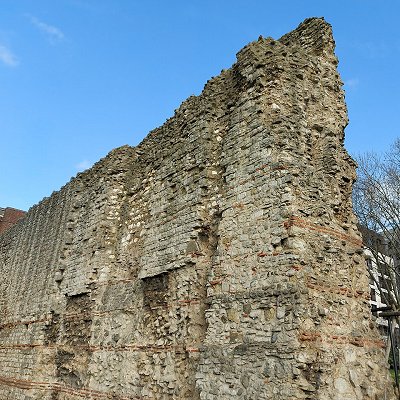
Tower Hill rises from the north bank of the River Thames to reach a maximum height of 14.5 metres (48 ft) Ordnance Datum. The land was historically part of the Liberties of the Tower of London, an area the Tower authorities controlled to keep clear of any development which would reduce the defensibility of the Tower. Building has encroached to a degree, but a legacy of this control is that much of the hill is still open. The hill includes land on either side of the London Wall, a large remnant of which is visible.
Generally speaking, the name Tower Hill informally applies to those parts of the Tower Liberty that are outside the Tower of London and its moat. Great Tower Hill is the land lying inside (or west) of the line of the London Wall whereas Little Tower Hill is the land outside (or east) of the wall.
After the abandonment of Tower Hill as a site for public executions, Trinity Square and Gardens were laid out in 1797 by Samuel Wyatt as the setting for Trinity House, completed a year earlier as headquarters of the Corporation of Trinity House.
In the 1880s, a section of the London Underground Circle Line was constructed beneath Trinity Square Gardens. In the first decade of the 20th century small buildings, courts and yards bordering Trinity Square were cleared to make way for the construction of the Port of London Authority headquarters at 10 Trinity Square. Begun in 1912 and completed in 1922, the Grade II* building is now a Four Seasons hotel which opened as such on 26 January 2017.
The Merchant Navy Memorial, First World War section, Grade I-listed, was unveiled by Queen Mary (deputising for her husband, King George V) on 12 December 1928. To avoid overshadowing this, the Grade II* Second World War section is in the form of a sunken garden and was unveiled by The Queen on 5 December 1955 while that commemorating merchant seamen killed in the 1982 Falklands War was unveiled on 4 September 2005 by the First Sea Lord, Admiral Sir Alan West.
Tower Hill Terrace is the pedestrian way that runs south off Tower Hill to Gloucester Court and also the adjoining paved public space, redeveloped in 2019, atop the Tower Vaults shopping complex. A floor plaque in Tower Vaults commemorates its re-opening in 1991 as the surviving part of the 1864 George Myers built Mazawattee Tea Warehouse, extensively bomb-damaged in Second World War air raids and later demolished.
No. 7 of the original 31 Tower Liberty boundary markers is sited at the bottom of the steps linking Gloucester Court to Tower Hill Terrace and no. 8 is positioned at the base of the circular concrete air duct adjoining Tower Hill.
Immediately east of the Tower of London Welcome Centre on Great Tower Hill are the buried structural remains of the medieval Bulwark Gate and bastion. The lower half of Tower Hill was enclosed in the late 15th century to protect the western entrance to the Tower of London. The large brick bastion commissioned by Edward IV extended part way up Tower Hill from Tower Dock, but was demolished in 1668.
Tower Subway is a tunnel under the Thames running from Tower Hill to Vine Lane in Southwark. The round brick-built entrance building near the Tower of London's ticket office was constructed in 1926 by the London Hydraulic Power Company. The year of 1868 visible on the structure refers to the Tower Subway Act 1868 which authorised the construction of the tunnel.
The grade II listed former pump house (Tower of London shop) was built in 1863 and designed by the architect Anthony Salvin.
|
 Feel free to Email me any additions or corrections Feel free to Email me any additions or corrections
LINKS AVAILABLE TO YOUR SITE
| |


