
Like us on Facebook
PLACE NAMES


|
|
Newington
|
| |
 | Piccadilly Circus Underground - 0343 222 1234
Level 2 Information Desk, Tate Modern - 020 7401 5266
visit@cityoflondon.gov.uk
|
The name means "new farmstead" or the newer part of the manor of Walworth but because of its position on the principal road to the south-coast (Stane Street) subsumed it. The first mention of Newington (or Neweton) occurs in the Testa de Nevill (a survey of feudal tenure officially known as the Book of Fees compiled 1198–1242) during the reign of Henry III, wherein it is stated that the queen's goldsmith holds of the king one acre of land in Neweton, by the service of rendering a gallon of honey. In 1313 it is mentioned again in the Archbishop of Canterbury's Register as Newington juxta London. The name survives now in the street names Newington Causeway and Newington Butts and in the open space Newington Gardens, formerly the location of Horsemonger Lane Gaol from 1791. Newington Ward is one of three local council wards in Walworth, covering the area from the West side of Walworth road up to the border with Lambeth.
The area remained as a farming village with a low level of population until the second half of the 18th century. There was a little industry, for example, the manufacture of clay pipes for tobacco smoking. In William Shakespeare's time, there was a theatre called Newington Butts and later there were further theatres. Newington gained in importance with the creation of the Westminster Bridge in 1750 and the associated improvements of London Bridge which required a series of new roads across St George's Fields to interconnect the routes from them and allow traffic from the Georgian West End to travel south and to Southwark without transitting through the City. These routes were Westminster Bridge Road and Borough Road for the West End and Southwark; for the route to the south London Road and St George's Road supplemented and by-passed the Borough High Street and Newington Causeway. All of these roads converged at a junction where there was a blacksmith's forge and inn called Elephant and Castle which then became a name to signify the area. Traffic heading to the south-east from the West End was connected to the older route from the City of London and Southwark to Kent as New Kent Road from Newington to a junction with the older route at the Bricklayers Arms. New roads brought development opportunities. The local landowner, Henry Penton (MP for Winchester), started to sell some of his farmland. The 19th century brought more dense speculative house building, and some philanthropic provision too. The Trinity House Newington Estate, laid out on property the institution was left in the seventeenth century, became a high class residential district which is still largely in existence. It was built around an 1820s classical church by Francis Octavius Bedford.
At the southern end is now a traffic circle and shopping centre. "The Elephant", as locally abbreviated, consists of major traffic junctions connected by a short road called Elephant and Castle, part of the A3. Between these junctions, on the eastern side, is the Elephant and Castle Shopping Centre, with the Hannibal House office block above. To the north of this, bounded by Newington Causeway and New Kent Road is the large Metro Central Heights residential block. The 43-storey Strata residential block lies just south of the shopping centre on Walworth Road.
Traffic runs to and from the south-east of England along the A2 (New Kent Road and Old Kent Road), the south of England on the A3, to the West End via St George's Road, and to the City of London via London Road and Newington Causeway at the northern junction. Newington Butts and Walworth Road adjoin the southern junction. The whole junction forms part of the London Inner Ring Road and part of the boundary of the London congestion charge zone.
The Elephant has two linked London Underground stations, on the Northern and Bakerloo lines, and a National Rail station served by Southeastern (Kentish Town to Sevenoaks via Catford) and Thameslink Railway (Thameslink suburban loop to Sutton and Wimbledon, and other Thameslink services to Kent).
Local buildings include Skipton House, part of the Department of Health; Perronet House, an award-winning residential block owned by Southwark Council; a large part of the London South Bank University campus; the London College of Communication; the Ministry of Sound nightclub; and the Metropolitan Tabernacle. The Cuming Museum is nearby on Walworth Road.
The name "Elephant and Castle" is derived from a coaching inn. The earliest surviving record of this name relating to the area appears in the Court Leet Book of the Manor of Walworth, which met at "Elephant and Castle, Newington" on 21 March 1765. Previously the site was occupied by a blacksmith and cutler - the coat of arms of the Worshipful Company of Cutlers features an elephant with a castle (possibly meant to be a howdah) on its back, which in turn was used because of the use of elephant ivory in handles.
Shakespeare mentions the Elephant Lodgings in "Twelfth Night". In Act 3 Scene 3 Antonio says "In the south suburbs, at the Elephant, is best to lodge." Although the play is set in Illyria in the Balkans, Shakespeare often used local London references. The theatres were all in Southwark, so Shakespeare's line may represent an advertisement for a local hostelry. "The Elephant" is a common present-day nickname for the Elephant and Castle.
The inn site was rebuilt in 1816 and again in 1898, and the present Elephant & Castle pub, at the junction of New Kent Road and Newington Causeway, was part of the 1960s comprehensive redevelopment. The entire area has since been developed yet again with changes to traffic priorities.
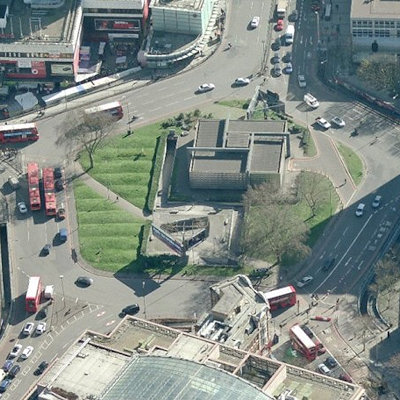
In the middle of the northern junction island is the Michael Faraday Memorial, a large stainless steel box built in honour of Michael Faraday, who was born nearby.
|
 Feel free to Email me any additions or corrections Feel free to Email me any additions or corrections
LINKS AVAILABLE TO YOUR SITE
| |
