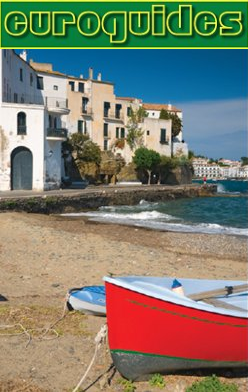
Almería is a city and municipality of Spain, located in Andalusia. It is the capital of the province of the same name. The city lies in southeastern Iberia, extending primarily in between the eastern fringes of the Sierra de Gádor and the Andarax riverbed along the coastline of the Gulf of Almería, a large inlet of the Mediterranean Sea. The municipality has a population of 201,946.
Caliph Abd al-Rahman III founded the city in 955. The city grew wealthy during the Islamic era, becoming a world city throughout the 11th and 12th centuries. It enjoyed an active port that traded silk, oil, and raisins. This period was brought to an end with the 1147 conquest of the city by a Christian coalition. Control over Almería switched hands over the rest of the middle ages. In the early modern period, with the onset of Barbary piracy, the ethnic cleansing of moriscos in the Kingdom of Granada, and several natural calamities, urban decay accrued. The 19th-century reactivation of mining activity (lead) in the hinterland fostered commercial activity and demographic growth.
Key road routes include the A-7 connecting Almería to the rest of the Spanish Mediterranean coast and the A-92 connecting the city to Granada and inner Andalusia. Almería is served by a medium-sized airport and a port with a growing specialization in passenger and ro-ro transport with the North of Africa (Algeria and Morocco).
Being adjacent to a small desert, Almería has an exceptionally dry climate by European standards.
The name "Almería" comes from the city's former Arabic name, Madinat al-Mariyya, meaning "city of the watchtower". As the settlement was originally the port or coastal suburb of Pechina, it was initially known as Mariyyat al-Bajjana (Bajjana being the Arabic name for Pechina).
The origin of Almería is connected to the 9th-century establishment of the so-called Republic of Pechina (Bajjana) some kilometres to the north, which was for a time autonomous from the Cordobese central authority: the settlement of current-day Almería initially developed as a humble trading port of Pechina known as Al-Mariyya Bajjana. Pechina and its maritime port experienced divergent fortunes, and while the former progressively depopulated, the latter became the base of the Caliphal navy after 933, during the rule of Abd-ar-Rahman III. The port suffered a devastating Fatimid naval attack in 955 that exposed the Caliphate's defensive shortcomings. Also in 955, Abd-ar-Rahman III decided to erect the walls. A silk industry consisting of hundreds of looms and feeding itself from the mulberry trees planted in the region, fostered Almería's economy. Almería also became an important slave trade hub during the caliphal period.
In the wake of the collapse of the Caliphate of Córdoba in the early 11th century, Almería detached from Cordobese authority towards 1014 and became ruled as an independent taifa under Slavic kinglets. It submitted to the Taifa of Valencia in 1038, yet it soon became independent as a new taifa, ruled by the Arab Banu Sumadih until 1091, when it fell to Almoravid control. This allowed the city's economy to insert itself into the trade networks of the Almoravid empire. Building upon the previous development during the caliphal period, Almería reached a degree of historical relevance unmatched in the rest of its history throughout the 11th and 12th centuries, becoming the third-largest city of Al-Andalus. Almería imported indigo dye and wool from the Maghreb and linen from Egypt, while it exported copper to Fez and Tlemcen as well as its highly sought textiles.
Contested by the emirs of Granada and Valencia, Almería experienced many sieges, including one especially fierce siege when Christians, called to the Second Crusade by Pope Eugene III, were also encouraged to counter the Muslim forces on a more familiar coast. On that occasion Alfonso VII, starting on 11 July 1147, at the head of mixed armies of Catalans, Genoese, Pisans and Franks, led a crusade against the rich city, and Almería was captured on 17 October 1147, marking the breakup of the city's period of splendor in the Middle Ages.
Within a decade, in 1157, Almería had passed to the control of Muslim Almohad rulers. Almería soon passed by the temporary overarching control of rebel Murcian emir Ibn Mardanish (1165-1169), hindering the early efforts of recovery in the city, that under the decade of Christian occupation reportedly had been left depopulated and, by and large, quite destroyed. During Almohad rule, the city did not return to its previous splendor, although the port remained trading with the Crown of Aragon and the Italian republics.
Following the rebellion against Almohad rule heralded by the likes of the Banu Hud and the Banu Mardanis, Almería submitted to the authority of Ibn Hud, who had raised the black banner and pledged nominal allegiance to Abbasid authorities by 1228. After Ibn Hud's assassination in Almería in 1238, the bulk of the remaining Muslim-controlled territories in the Iberian Peninsula passed to the control of rival ruler Ibn al-Ahmar (sultan since 1232), who had set the capital of his emirate in Granada by 1238, constituting the Emirate of Granada, to which Almería belonged from then on. While relatively languishing throughout the Nasrid period, Almería still remained a key strategic port of the emirate together with Málaga, as well as a haven for pirates and political dissidents. It sustained intense trading relations with Aragon and the African port of Honaine. Almería endured a brutal siege by Aragonese forces in 1309 that, while eventually unsuccessful, left the city battered.
The city submitted to the sovereignty of the Catholic Monarchs on 22 December 1489.[34] Relatively isolated and within the range of attacks from Barbary pirates, the hitherto mercantile city entered modernity by undergoing a process of heavy ruralization that imperiled its very same continued existence as a city.
Historically, there was a Jewish community in Almería dating to the 10th century, where members of the community mostly engaged in maritime trade. When the Jews were expelled in 1492, many living in Almería fled to North Africa.
The 16th century was for Almería a century of natural and human catastrophes; for there were at least four earthquakes, of which the one in 1522 was especially violent, devastating the city. The people who had remained Muslim were expelled from Almería after the War of Las Alpujarras in 1568 and scattered across the Crown of Castile. Landings and attacks by Barbary pirates were also frequent in the 16th century, and continued until the early 18th century. At that time, huge iron mines were discovered and French and British companies set up business in the area, bringing renewed prosperity and returning Almería to a position of relative importance within Spain.
During the Spanish Civil War the city was shelled by the German Navy, with news reaching the London and Parisian press about the "criminal bombardment of Almería by German planes". Almería surrendered in 1939, being the last Andalusian main city to fall to Francoist forces.
In the second half of the 20th century, Almería witnessed spectacular economic growth due to tourism and intensive agriculture, with crops grown year-round in massive invernaderos - plastic-covered "greenhouses" - for intensive vegetable production.
After Franco's death and popular approval of the new Spanish Constitution, the people of southern Spain were called on to approve an autonomous status for Andalusia region in a referendum. The referendum were approved with 118,186 votes for and 11,092 votes against in Almería province, which represented 42% of all registered voters.
Due to its arid landscape, numerous Spaghetti Westerns were filmed in Almería and some of the sets still remain as a tourist attraction. These sets are located in the desert of Tabernas. The town and region were also used by David Lean in Lawrence of Arabia (1962), John Milius in The Wind and the Lion (1975), The Gospel of John (2003) and others.
One of Almería's most famous natural spots is the Cabo de Gata-Níjar Natural Park. This park is of volcanic origin, and is the largest and most ecologically significant marine-terrestrial space in the European Western Mediterranean Sea.[citation needed] The Cabo de Gata-Níjar Natural Park runs through the municipal areas of Níjar, Almerimar and Carboneras. Its villages, previously dedicated to fishing, have become tourism spots. The beaches of Cabo de Gata-Níjar Natural Park are also an attraction.
Almería has one islet that it administers as a part of its territory in the Alboran Sea, Alboran Island. The island has a small cemetery, a harbor, and a lighthouse, built in the 19th century.
In 2000, a team of geologists found a cave filled with giant gypsum crystals in an abandoned silver mine near Almería. The cavity, which measures 8 by 1.8 by 1.7 metres (26.2 ft × 5.9 ft × 5.6 ft), may be the largest geode ever found. The entrance of the cave was blocked by five tons of rocks, and was under police protection (to prevent looters from entering). According to geological models, the cave was formed during the Messinian salinity crisis 6 million years ago, when the Mediterranean sea evaporated and left thick layers of salt sediments (evaporites). The site is currently open for tourists under guided tours.
Main sights include:
- The Alcazaba, a medieval fortress that was begun in the 10th century but destroyed by an earthquake in 1522. It includes a triple line of walls, a majestic keep and large gardens. It commands a city quarter with buildings dressed in pastel colors, of Muslim-age aspect. It is the second largest among the Muslim fortresses of Andalusia, after the Alhambra.
- Almería air raid shelters, underground galleries for civilian protection during the Spanish Civil War, currently the longest in Europe open for tourists.
- The Cathedral has a fortress-like appearance due to its towers, merlons and protected paths, created to defend it from Mediterranean pirates. Originally designated as a mosque, it was later converted into a Christian church, before being destroyed in the 1522 earthquake. In the 16th century it was rebuilt in the Renaissance style, whilst keeping some of its defensive features.
- Renaissance church of Santiago, built in 1533, with tower and portal decorated with reliefs.
- Chanca, a group of houses carved into rocks.
- Castle of San Cristobal, now in ruins. It is connected to the Alcazaba by a line of walls.
- Museum of Almería. Includes findings from Prehistoric, Iberic, Roman, Greek ages and Muslim objects, mostly from the Alcazaba.
- Paseo de Coches, a modern seaside promenade with gardens and palms.
- Cable Inglés (English Pier), 1904 iron railway pier built to transfer iron ore, copper, and silver produced by British- and French-run mines in Granada from trains to waiting cargo ships.
- House of the Butterflies: Famous natives of Almería include Nicolás Salmerón y Alonso, who in 1873 was the third president of the First Spanish Republic, as well as several musicians, including the composer José Padilla Sánchez, whose music was declared of "universal interest" by Unesco in 1989, the popular folk singer Manolo Escobar, renowned Flamenco guitar player José Tomás "Tomatito" and Grammy Award winner David Bisbal; the champion motorcyclist Antonio Maeso moved to Almería as a child.
 Feel free to Email me any additions or corrections Feel free to Email me any additions or corrections
LINKS AVAILABLE TO YOUR SITE
| |