
Like us on Facebook
PLACE NAMES


 
|
|
Wanstead
|
|
|
|
Wanstead is a suburban area in the London Borough of Redbridge. The place name is first recorded in a charter of 1065 as Wenstede. The first element appears to mean 'wain' or 'wagon' but the meaning of the full compound is not clear. An alternative explanation is that the place name derives from the Anglo-Saxon words meaning "settlement on a small hill".
Wanstead was a part of the Municipal Borough of Wanstead and Woodford in Essex until 1965, when Greater London was created. The town has a largely suburban feel, containing open grasslands such as Wanstead Flats, and the woodland of Wanstead Park (part of Epping Forest). The park, with artificial lakes, was originally part of the estate of a large stately home Wanstead House, one of the finest Palladian mansions in Britain, from its size and splendour nicknamed the English Versailles, and the architectural inspiration for Mansion House, London. It was demolished after the bankruptcy of the owner, William Wellesley-Long, in 1824. It is also home to Wanstead Golf club, which has hosted many of the major events in the Essex County calendar. A notable landmark towards the northern edge of Wanstead is the former Wanstead Hospital building, now a housing complex. A small annex of the old Burns Unit is now used for research on Flu vaccines and bovine diseases.
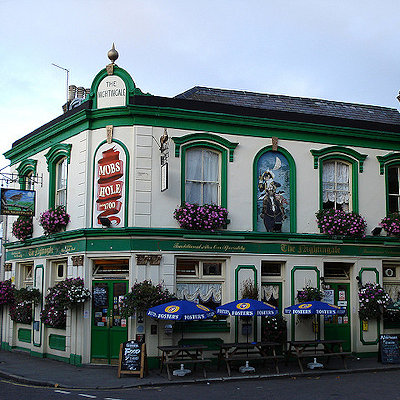
The main road going through Wanstead is the A12. Wanstead High Street includes pubs and independent retailers.
In 1707 the astronomer James Pound became rector of Wanstead. In 1717 the Royal Society lent Pound Huygens's 123-foot focal length object-glass, which he set up in Wanstead Park. Pound's observations with it of the five known satellites of Saturn enabled Halley to correct their movements; and Newton employed, in the third edition of the Principia, his micrometrical measures of Jupiter's disc, of Saturn's disc and ring, and of the elongations of their satellites; and obtained from him data for correcting the places of the comet of 1680. Laplace also used Pound's observations of Jupiter's satellites for the determination of the planet's mass; and Pound himself compiled in 1719 a set of tables for the first satellite, into which he introduced an equation for the transmission of light.
Pound trained his sister's son, James Bradley, and many of their observations were made together, including the opposition of Mars in 1719, and the transit of Mercury on 29 October 1723.
In 1727, Bradley embarked upon a series of observations using a telescope of his own, erected at the rectory in Wanstead, now the site of Wanstead High School. This instrument had the advantage of a large field of view and he was able to obtain precise positions of a large number of stars that transited close to the zenith over the course of about two years. Combined with observations from his friend Samuel Molyneux's house at Kew in Surrey, this established the existence of the phenomenon of aberration of light, and also allowed Bradley to formulate a set of rules that would allow the calculation of the effect on any given star at a specified date.
|
 Feel free to Email me any additions or corrections Feel free to Email me any additions or corrections
LINKS AVAILABLE TO YOUR SITE
| |


